Arcade games look intimidating from outside because experienced players make them look reactive. They are not, mostly — they are anticipatory, and anticipation is learnable in a way that raw reaction speed is not.
This guide gives you a starting order, four habits worth building immediately, and an honest picture of what your first hour will feel like.
Start with these three, in this order
- Starship Sprint. Direct controls, one thing to do, no combo system to manage. It teaches spatial anticipation with nothing competing for your attention.
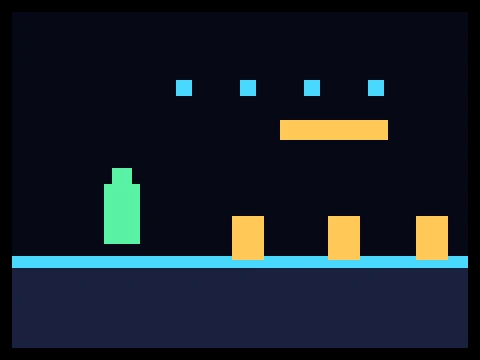
- Pixel Runner. Two inputs, timing-based. It teaches you that arcade games have a rhythm and that the rhythm is learnable.
- Neon Catcher. Introduces the multiplier concept in the gentlest form on the site — missing things is free, only hazards break your streak.
 Play it now
Starship Sprint
Steer a small starship through a scrolling hazard field of meteors, gates and energy barriers.
After those three you will have the three core skills — anticipation, timing and multiplier management — and everything else on the site is a variation on them.
The four habits
1. Look ahead, not at yourself
The most common beginner error, in every genre here. Your hands know where your character is. Your eyes should be on the part of the screen where the next problem is arriving — roughly the top third in vertical games, a third of the screen ahead in side-scrollers.
2. Keep moving
Standing still feels like control and is almost always wrong. In shooters it makes you a target; in survival games it lets enemies surround you; in racers it means you are not carrying speed. If in doubt, circle.
3. Do not chase pickups
Every game here places some collectibles deliberately in dangerous positions. A pickup is worth taking if it is on your route and worth ignoring if it is not. This one habit will extend your runs immediately.
4. Read the controls page before playing
Every game page on this site has a full control table below the play area. It takes twenty seconds to read and it frequently contains a mechanic — the short hop in Pixel Runner, the handbrake in Retro Racer — that a player can otherwise miss entirely.
What your first hour will actually look like
| Time | What happens | What it means |
|---|---|---|
| 0-10 min | Runs end in under 30 seconds | Normal. You are learning the input mapping. |
| 10-25 min | Runs reach 60-90 seconds; a plateau appears | You have the controls; you lack positioning. |
| 25-40 min | A sudden jump after one insight | This is how arcade improvement works — steps, not slopes. |
| 40-60 min | Consistent runs, occasional much better one | You are now improving. Stop before fatigue sets in. |
The step-shaped improvement is worth expecting. Progress in these games is not gradual — it comes in jumps when a specific realisation lands, and between the jumps it feels like nothing is happening. It is.
Things that are not your fault
- Your first run of a session being bad. Warm-up effects are real and measurable. Treat run one as practice.
- Touch controls being less precise than a keyboard. They are. This is true of the medium, not of you.
- Being much better at one genre than another. These skills genuinely do not transfer well. It is not a general aptitude.
- Getting worse after twenty minutes. Focused attention degrades. Take a break rather than pushing through.
Where to go next
Once the first three feel comfortable, branch by what you enjoyed:
- Liked the dodging? → Cosmic Dodge and Laser Grid
- Liked the timing? → Pixel Jumper and Retro Rocket
- Liked the scoring? → Pixel Blaster and Neon Highway
- Want to think rather than react? → Crystal Collector and Pixel Defense
Key Takeaways
- Start with Starship Sprint, Pixel Runner and Neon Catcher — in that order.
- Look ahead, keep moving, ignore off-route pickups, and read the control table.
- Improvement comes in steps, not slopes. The plateaus are part of it.
- Warm-up effects and post-twenty-minute decline are real and not your fault.
- Branch by what you enjoyed, not by what looks impressive.