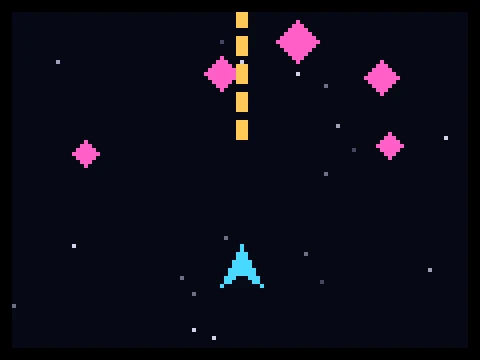
Pixel Blaster
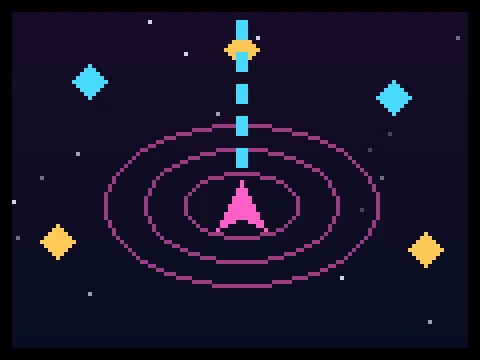
A twin-stick arcade shooter where you move with WASD and aim with the mouse against escalating enemy waves.
WASD + Mouse
Classic Arcade Action is the heart of Retro Arcade Hub. These are the games built the way coin-op cabinets were: you understand them in ten seconds, you are competent in ten minutes, and you are still chasing a better run an hour later. Nothing here has a tutorial, a cutscene or a save file. There is a score, there is a difficulty curve that never stops climbing, and there is the run you just had — which you can always beat.
7 playable games in this category. Every one is complete — there are no placeholders.
A twin-stick arcade shooter where you move with WASD and aim with the mouse against escalating enemy waves.

A top-down arena tank battle with destructible cover, ricochet shots and enemy AI.

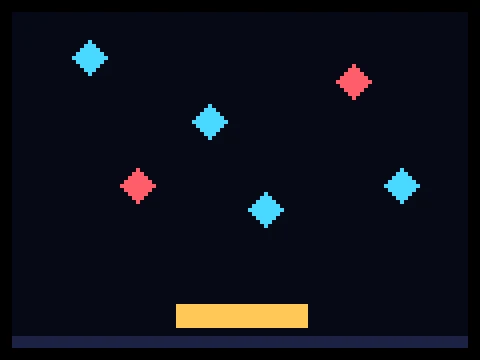
A 90-second round of catching valuable falling objects while avoiding the hazards that reset your streak.
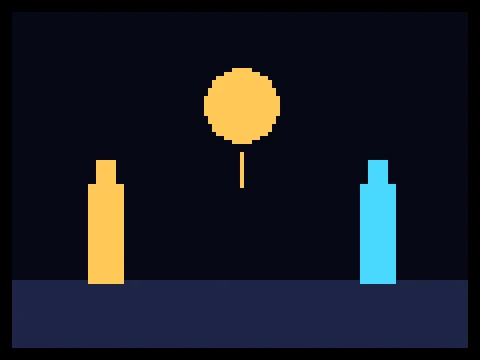
A draw-on-the-signal reaction duel against a ladder of AI opponents with rising reaction speeds.
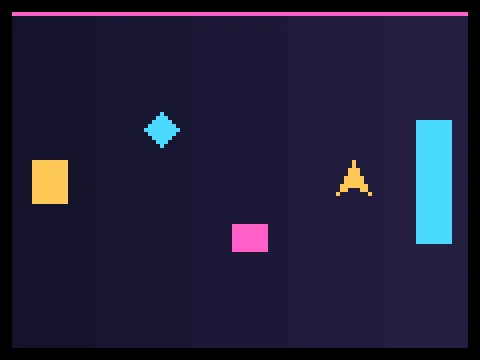
Five arcade challenge types rotating in one continuous run, sharing a single score and life pool.
The flagship game: six stages combining shooting, dodging, collecting, platforming and timing, with bonus rounds.
Three things, and they reinforce each other. First, the input vocabulary is tiny — move and one action, sometimes two. Second, the failure state arrives quickly and is always legible: you can point at the exact moment you lost. Third, the difficulty is a function of time survived rather than a series of hand-authored levels, so every run is a fresh negotiation with the same rules. That combination is why a 1980s cabinet could hold someone's attention for an hour with a few kilobytes of code.
Each one runs on the same HTML5 Canvas engine, with a fixed logical resolution and delta-time physics, so a game behaves identically on a 60 Hz laptop and a 144 Hz desktop. Difficulty ramps use an asymptotic curve rather than a linear one: pressure rises quickly in the first minute, then flattens, so a long run stays hard without becoming impossible. Every game gives you a short invulnerability window after a hit, because an unavoidable second death is not difficulty, it is a bug.
What defines an arcade game, how the six main families differ, and how to get better at all of them.
Nine concrete, testable methods — multiplier management, positioning, session length and error diagnosis.
No. Every game here is an original design written for this site. They borrow the structural ideas of arcade gaming — score attack, wave pressure, one-more-run pacing — but the mechanics, artwork, enemy designs and audio are all original. No commercial game's characters, sprites, sounds or level layouts are reproduced.
No. Each game is HTML5 and Canvas, running directly in the browser tab. There is no plugin, no installer and no account.
No. Your best score is written to your browser's localStorage on your own device. It is not sent to a server and it does not sync between devices or browsers.
Pixel Blaster if you want a straightforward score-attack shooter, One-Tap Arcade if you want the shortest possible learning curve, and Ultimate Retro Arcade if you want the most varied challenge on the site.
Original space shooters, meteor fields, tunnel flights and orbital challenges set against scrolling starfields.
5 gamesJumping, timing and precise movement — endless runners, tower climbs, collectible hunts and physics platformers.
5 gamesTop-down time trials, endless traffic runs and drift-scoring challenges built for short, repeatable sessions.
3 gamesReaction tests, mazes, timing puzzles, brick breaking and pattern recognition — thinking games that still run on a clock.
6 gamesEndless waves, base protection and threat prioritisation — how long can you hold out as the pressure compounds?
4 games