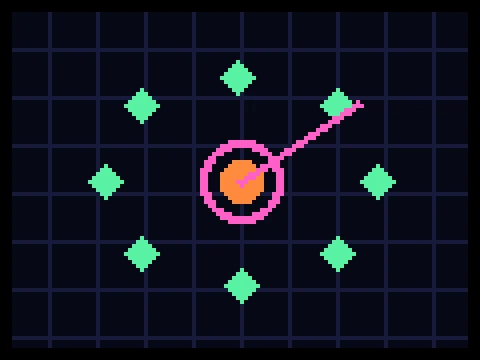
Neon Defender
Rotate a cannon around a central core and hold back waves of converging enemies.
Arrow keys + Space
Survival and defence games ask a different question from the rest of the site. Everywhere else, the question is “how well can you execute?” Here it is “what will you sacrifice?” You cannot stop every threat. The games are designed so that the incoming pressure eventually exceeds your ability to answer it, and the interesting decisions all happen in the gap — which threat you ignore, which upgrade you take, which part of your base you let go.
4 playable games in this category. Every one is complete — there are no placeholders.
Rotate a cannon around a central core and hold back waves of converging enemies.

Defend a base from escalating waves, choosing one upgrade between each wave.

An endless arena survival game where enemies never stop arriving and never despawn.

Defend six cities from incoming objects when you cannot possibly intercept them all.
Retro Defender makes this explicit: multiple targets, incoming objects with different speeds and different times-to-impact, and not enough time to answer all of them. The correct heuristic is almost never “nearest first” — it is “soonest first, weighted by what it destroys”. Learning to compute that quickly, under pressure, is the whole discipline.
Every wave-based game here gives you a short breathing space between waves. That gap is not generosity — it is where the strategic layer lives. It is when you take an upgrade, reposition, and decide what your plan for the next thirty seconds is. Players who spend the gap doing nothing are playing a strictly harder game.
Threat triage, rate management, upgrade ordering, cluster control and wave gaps.
Rate problems, difficulty plateaus, pacing a long run and recognising when a run is already lost.
Arcade Survival and Pixel Defense are endless — the difficulty keeps rising and the run ends when you do. Neon Defender and Retro Defender have wave milestones with clear checkpoints, but no final wave.
Pixel Defense has an upgrade choice between waves, which is the closest thing on the site. There is no free-placement building phase — these are action defence games, not tower defence.
Wave 10 in Pixel Defense and three minutes in Arcade Survival are solid intermediate benchmarks. Your own previous best is the only comparison the site makes — there is no global ranking.
By design. The ramp is a function of elapsed time, not of your performance. That keeps every run comparable to every other run, which is what makes a personal best meaningful.
Fast, reflex-driven arcade games built around short levels, rising pressure and a score you want to beat.
7 gamesOriginal space shooters, meteor fields, tunnel flights and orbital challenges set against scrolling starfields.
5 gamesJumping, timing and precise movement — endless runners, tower climbs, collectible hunts and physics platformers.
5 gamesTop-down time trials, endless traffic runs and drift-scoring challenges built for short, repeatable sessions.
3 gamesReaction tests, mazes, timing puzzles, brick breaking and pattern recognition — thinking games that still run on a clock.
6 games