
Retro Defender
Defend six cities from incoming objects when you cannot possibly intercept them all.
Mouse or touch
Survive as long as possible in a closed arena against a continuously growing enemy population.
Arcade Survival has one rule that defines everything about it: enemies do not despawn. They arrive, they pursue, and they stay until you kill them. There is no wave clear, no breathing room and no moment where the arena is empty. The population you are facing at any point is the cumulative result of every enemy that has spawned minus every one you have destroyed, which means falling behind is permanent and compounding.
That single design choice turns the game into a rate problem. Your kill rate is roughly fixed by your fire rate and accuracy. The spawn rate rises on a curve. There is a crossover point — usually somewhere between ninety seconds and three minutes depending on your skill — past which the population grows faster than you can cut it. Everything after that crossover is managed decline, and how long you can extend it is your score.
Space management is therefore the real skill. Enemies pursue directly, which means a moving player naturally forms them into a trailing cluster. That cluster is both your biggest threat and your biggest opportunity — it is where your shots hit multiple targets. Learning to lead a cluster in a wide circle while cutting into it is the technique the entire game is built to teach.
Survive as long as possible in a closed arena against a continuously growing enemy population.
| Input | Action |
|---|---|
| W A S D or Arrow keys | Move |
| Mouse | Aim |
| Left mouse button or Space | Fire |
| Shift | Short dash on a cooldown |
| P or Escape | Pause and resume |
| R | Restart |
| Touch joystick + Fire button | Move and fire (mobile) |
Every game on this site can be paused with P or Esc and restarted with R. Sound, retro screen effects and fullscreen are toggled from the buttons above the play area.
Nothing despawns. The arena's enemy count is a running total. This is what makes the game genuinely hard rather than merely fast — you are fighting your own accumulated deficit.
Enemies pursue your current position directly, so consistent movement in one direction forms them into a queue behind you. A tight cluster lets one shot hit several enemies, which is the only way to keep pace with the spawn curve past two minutes.
You have eight health rather than lives, and health pickups drop rarely from destroyed enemies. Because they drop where the enemy died, the pickup is always inside the cluster you just cut through — a deliberate risk you have to price.
| Action | Value |
|---|---|
| Enemy destroyed | 75 points x combo multiplier |
| Survival | 30 points per second |
| Multi-kill (3+ with one shot) | 150 point bonus |
| Combo multiplier | Up to x8, resets when you take damage |
Your best result is saved in this browser only. Nothing is uploaded, and there is no global leaderboard — see the storage policy for exactly what is kept.
No. The spawn rate rises continuously and nothing despawns. The run ends when you do.
Because Pixel Blaster clears waves and gives you empty moments. Here the population is cumulative, so falling behind is permanent.
Eight points, with rare drops from destroyed enemies. There are no lives — one health bar for the whole run.
Two minutes is a strong intermediate result. Four minutes means your cluster management is genuinely working.
Chosen by shared category, tags and difficulty — not padded with unrelated titles.
Defend six cities from incoming objects when you cannot possibly intercept them all.
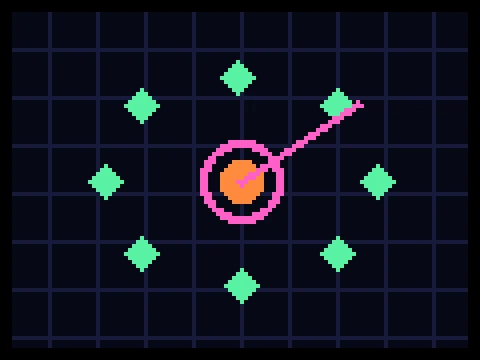
Rotate a cannon around a central core and hold back waves of converging enemies.
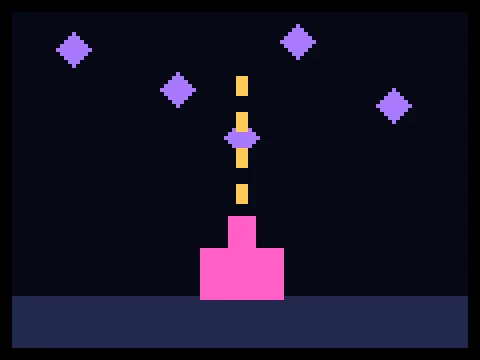
Defend a base from escalating waves, choosing one upgrade between each wave.

A top-down arena tank battle with destructible cover, ricochet shots and enemy AI.
What defines an arcade game, how the six main families differ, and how to get better at all of them.
Rate problems, difficulty plateaus, pacing a long run and recognising when a run is already lost.
Threat triage, rate management, upgrade ordering, cluster control and wave gaps.