
Retro Defender
Defend six cities from incoming objects when you cannot possibly intercept them all.
Mouse or touch
Keep your base alive through as many waves as possible, spending each between-wave upgrade choice wisely.
Pixel Defense is the only game on the site with a genuine strategic layer. You aim and fire with the pointer, defending a base at the bottom of the screen from waves that descend from above. That part is straightforward action. The part that makes the game is what happens between waves: you are offered three upgrades drawn from a pool of eleven, and you must take exactly one.
Those choices compound. An early economy upgrade — faster reload, wider spread — pays dividends for the rest of the run. A late power upgrade — piercing shots, splash damage — is worth more at the point where individual enemies have enough health to matter. Taking them in the wrong order is the most common reason a run ends at wave 8 rather than wave 15, and it is a strategic mistake rather than an execution one.
The base has fifteen health and does not regenerate, but a single upgrade in the pool restores five. Whether to spend a choice on repair or on capability is the game's recurring dilemma, and there is no universally correct answer — it depends on your health, your current build, and how many waves you think you can still reach.
Keep your base alive through as many waves as possible, spending each between-wave upgrade choice wisely.
| Input | Action |
|---|---|
| Mouse move or touch drag | Aim |
| Left mouse button held / touch held | Fire continuously |
| 1 / 2 / 3 | Select an upgrade between waves |
| P or Escape | Pause and resume |
| R | Restart |
Every game on this site can be paused with P or Esc and restarted with R. Sound, retro screen effects and fullscreen are toggled from the buttons above the play area.
Eleven upgrades across three families. Economy: reload speed, projectile speed, and a second barrel. Power: piercing, splash, and damage. Utility: base repair, a temporary shield, slow field, extra score multiplier and a wave skip. You are offered three at random after each wave and must take one — you cannot decline.
Five enemy types with different health, speed and behaviour, including one that splits on death and one that heals nearby allies. Wave composition is drawn from a budget, so a wave might be many weak enemies or a few tough ones — and the correct build differs between those cases.
You fire continuously toward the pointer at your current reload rate. There is no ammunition. The skill is entirely in target prioritisation, because your damage output per second is fixed and choosing the wrong target is the same as not firing at all.
| Action | Value |
|---|---|
| Enemy destroyed | 40 to 250 points by type |
| Wave cleared | 400 points x wave number |
| Wave cleared with no base damage | 600 point bonus |
| Score multiplier upgrade | Adds a permanent +25% for the rest of the run |
Your best result is saved in this browser only. Nothing is uploaded, and there is no global leaderboard — see the storage policy for exactly what is kept.
No. You must take one of the three offered. This is deliberate — it forces you to make a decision under uncertainty rather than waiting for a perfect option.
No. There is no building or placement phase. You are the only weapon, and the strategy is in your upgrade path rather than in level layout.
Only through the repair upgrade, which restores five points. Otherwise damage is permanent for the run.
Wave 10 means your build is coherent. Wave 15 or beyond means you are also reading wave composition and prioritising targets correctly.
Chosen by shared category, tags and difficulty — not padded with unrelated titles.
Defend six cities from incoming objects when you cannot possibly intercept them all.
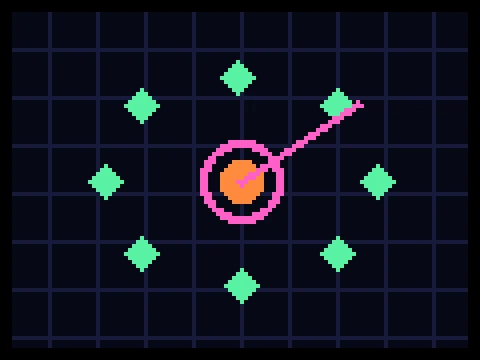
Rotate a cannon around a central core and hold back waves of converging enemies.

An endless arena survival game where enemies never stop arriving and never despawn.

A brick-breaking game with six original layouts, armoured bricks and five power-ups.
Nine concrete, testable methods — multiplier management, positioning, session length and error diagnosis.
Lives, waves, power-ups, invulnerability and spawn logic — the standard building blocks explained.
Threat triage, rate management, upgrade ordering, cluster control and wave gaps.