There are perhaps a dozen mechanics that appear across most arcade games. Each exists to solve a specific problem, and each creates a specific optimal response from the player. This guide covers the main ones and what to do about them.
Lives versus health
These are not interchangeable and choosing between them changes a game substantially.
| Lives | Health | |
|---|---|---|
| What a hit costs | A full attempt | A fraction of your capacity |
| After a hit | Reset position, brief invulnerability | Keep playing, degraded |
| Encourages | Careful play, then recovery | Sustained pressure management |
| Feels like | Discrete failure | Gradual attrition |
| Example here | Pixel Blaster, Pixel Jumper | Arcade Survival, Pixel Defense |
The player-facing consequence: in a lives game, the two seconds after a hit are the most important two seconds of your run, because you are invulnerable and repositioned. In a health game there is no such reset — damage accumulates and the correct response is to back off immediately.
The invulnerability window
After taking damage, most arcade games grant a short period during which you cannot be hit again. This exists to prevent a specific failure: taking a hit inside a crowded situation and then immediately taking two more before you can move.
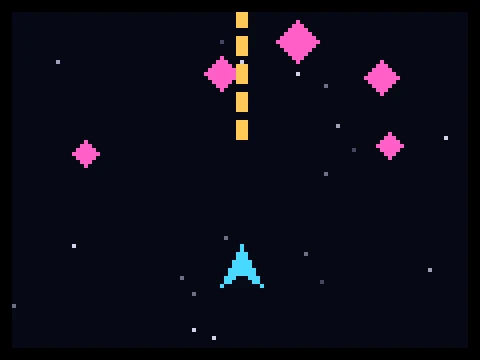
Games on this site grant 1.8 seconds after a life is lost and 1.4 seconds at the start of a run. That is enough to leave a bad situation and not enough to fight through one.
Invulnerability is for relocating, not for continuing. Players who keep fighting during it find themselves in exactly the same position when it expires, minus one life.
Wave structure and the gap
A wave is a discrete batch of enemies with a defined end. The alternative — continuous spawning — creates a very different game.
- Wave games have rhythm. Pressure builds, resolves, and there is a gap. The gap is where strategy lives: repositioning, upgrades, planning.
- Continuous games have no relief. Arcade Survival never clears, which is what makes it a rate problem rather than an execution problem.
If a game has wave gaps, using them is not optional. In Pixel Defense the upgrade chosen in the gap affects your final score more than the execution of any individual wave.
 Play it now
Pixel Defense
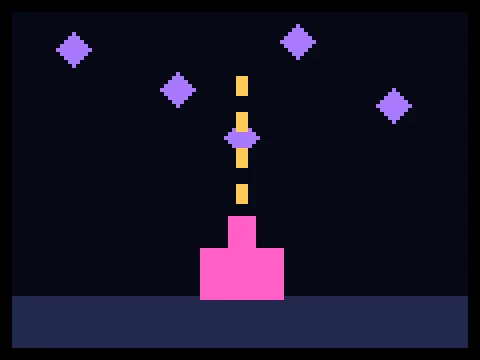
Defend a base from escalating waves, choosing one upgrade between each wave.
Power-ups and the expiry trap
Power-ups exist to create moments of temporary dominance, which is a pacing device. Almost all of them expire, and the expiry is the important design detail.
- Timed pickups (Pixel Blaster's eight-second weapons) create a use-it-now urgency. The trap is that crossing dangerous space to reach one costs more than the eight seconds are worth.
- Permanent upgrades (Pixel Defense) compound. Take the ones that multiply your other capabilities as early as possible.
- Instant effects (Neon Catcher's booster) have no duration to manage and are almost always worth taking.
Treating pickups as objectives. On every game on this site, the collectible placement is deliberately tempting rather than convenient. Take what is on your route.
Spawn logic
Enemies do not appear randomly in a well-made arcade game. There are three common patterns and recognising which one you are facing tells you where to stand.
- Edge spawning — enemies enter from the playfield boundary. The centre is the most-threatened position and the edges are the least, which is the opposite of intuition.
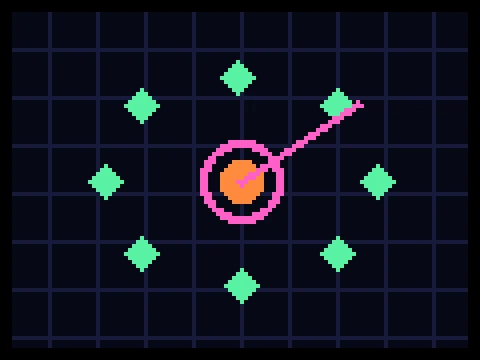
- Ring spawning — enemies appear on a circle around a fixed point. Neon Defender uses this; the correct play is to read the densest arc.
- Directed spawning — the spawn point is chosen relative to the player, usually to avoid spawning on top of them. This means moving continuously slightly increases spread.
One variant worth naming: adaptive spawning, where the generator weights spawns toward where you have been. Retro Orbit does this deliberately to prevent camping a comfortable radius.
The combo window
Combos require consecutive actions inside a time window, typically two to four seconds. The window length is a design lever with a clear effect:
- Short windows (under two seconds) demand aggression and produce high-variance scoring.
- Long windows (four seconds or more) reward consistency and let careful players build.
Neon Snake Arena uses four seconds, which is why holding a chain there means committing to distance. Pixel Blaster uses 2.2, which is why it feels aggressive.
Difficulty gates and thresholds
Some games change their rules at score or progress thresholds rather than continuously. One-Tap Arcade unlocks a second orbit ring at 3,000 points and a third at 9,000. Neon Snake Arena steps its speed at four defined lengths.
These are worth knowing because they are predictable. A player who knows a speed increase arrives at length 20 can play the approach to it conservatively, which is far better than discovering it mid-move.
Key Takeaways
- Lives and health are different systems that demand different responses to being hit.
- The invulnerability window is for relocating, never for continuing the fight.
- Wave gaps are where the strategic layer lives — using them is not optional.
- Power-up placement is designed to tempt you off your route. Take what is on it.
- Spawn logic is rule-based, not random. Learn the rule and you know where to stand.