Arcade games have a reputation for being punishing, and much of it is earned. But there is a precise distinction between a game that is hard and one that is unfair, and it is worth understanding because it tells you when to blame yourself and when to blame the design.
The three curve shapes
Linear
Difficulty rises at a constant rate for the whole run. Simple to implement and almost always wrong: it is either too easy for too long or it crosses into impossibility. Linear ramps are a sign a game's difficulty was not tuned.
Asymptotic
Rises quickly and then flattens toward a ceiling it approaches but never reaches. This is the default across this site. It produces a game that teaches quickly in the first ninety seconds and then holds at a high, stable pressure — so a long run is a test of consistency rather than an inevitable defeat.
Stepped
Difficulty jumps at defined thresholds and holds between them. Used where the player needs adjustment time. Neon Snake Arena steps its speed at lengths 10, 20, 35 and 55 rather than ramping smoothly, because a discrete change is easier to adapt to than a continuous one.
In an asymptotic game, surviving three minutes means you can probably survive six. In a stepped game, each threshold is a real wall requiring a new technique. Knowing which you are playing tells you whether to push or to prepare.
What separates hard from unfair
Four technical properties. A game with all four can be extremely difficult and still feel fair; a game missing any one of them feels arbitrary regardless of how gentle its curve is.
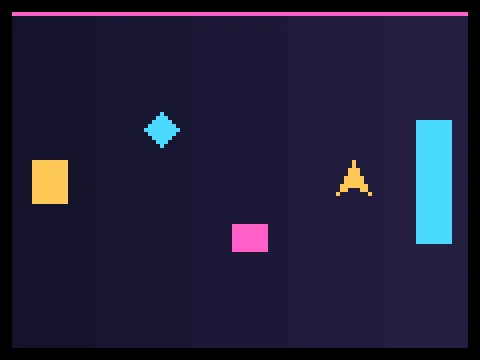
- Telegraphing. Every threat announces itself before it can kill you. Laser Grid flashes each barrier for 0.4 seconds before activation. Arcade Tower glows when the floor is within two platform heights.
- Recoverability. After taking damage you get a grace window. Without it, one hit in a crowded situation cascades into instant death and the player learns nothing.
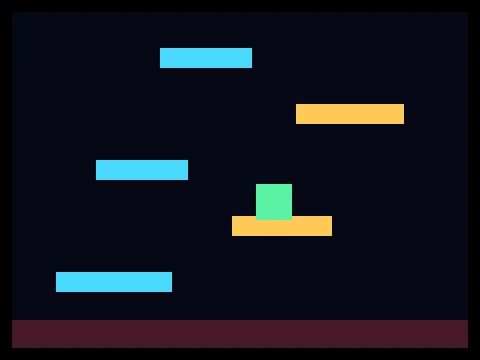
- Solvability. Every configuration the generator produces must be passable. Retro Rocket guarantees a minimum tunnel gap; Pixel Maze guarantees a valid key ordering.
- Legibility of cause. The player must be able to identify what killed them. If the answer is “something off screen”, the design has failed.
Difficulty that increases because the game wants the run to end — rather than because the curve says so — is the one genuinely bad practice the arcade era produced. It existed for revenue reasons. Modern arcade games have no reason to do it and this site's games do not.
How difficulty is actually tuned
Four independent variables, adjusted separately. Changing all of them at once is how you get a curve nobody can play.
| Variable | Effect | Typical range on this site |
|---|---|---|
| Spawn rate | How much pressure arrives | Halves over the first 90 seconds |
| Entity speed | How much reaction time you have | Rises 30-50% over a run |
| Entity health | How long threats persist | Usually fixed; varied by type instead |
| Safe space | How much room you have | Shrinks in survival games, fixed elsewhere |
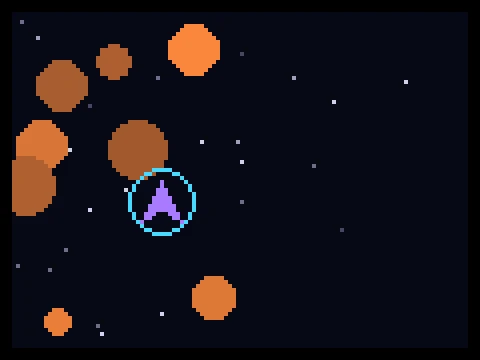
The most interesting of these is safe space. Cosmic Dodge does not make meteors faster — it simply stops removing them, so the available space shrinks monotonically. That is a difficulty ramp built entirely out of geometry, and it feels different from a speed ramp in a way players notice even if they cannot name it.
Difficulty labels and what they mean here
The four labels on this site are assigned by skill floor rather than by how punishing a game feels.
- Easy — playable well on a first attempt. One primary mechanic. Starship Sprint, Neon Catcher, Crystal Collector.
- Medium — requires learning one non-obvious technique. Pixel Blaster's combo management, Arcade Breaker's paddle angles.
- Hard — requires a control model that fights instinct. Cosmic Dodge's momentum, Retro Rocket's thrust, Arcade Tower's forced pace.
- Expert — requires competence across multiple skills simultaneously. High Score Hero and Ultimate Retro Arcade only.
 Play it now
Cosmic Dodge
Survive an endless meteor field using momentum-based flight and a cooldown dash.
Key Takeaways
- Asymptotic curves are the default because they teach fast and then hold at stable pressure.
- Fairness is four technical properties: telegraphing, recoverability, solvability and legible cause.
- Difficulty is tuned by spawn rate, speed, health and safe space — adjusted independently.
- Shrinking safe space is a difficulty ramp built from geometry rather than statistics.
- Difficulty labels here reflect skill floor, not how punishing a game feels.