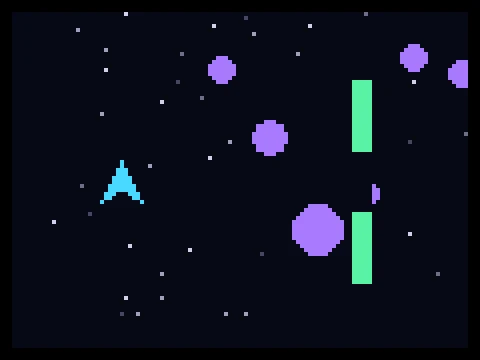
Starship Sprint
Steer a small starship through a scrolling hazard field of meteors, gates and energy barriers.
Arrow keys or WASD
Space was arcade gaming's first great setting, and for a good structural reason: a black background makes threats maximally readable, and zero-gravity movement gives designers a control model with real depth in almost no code. The games in this category use that inheritance to explore genuinely different problems — formation shooting, momentum management, spatial pressure and orbital timing — rather than repeating a single space-shooter template five times.
5 playable games in this category. Every one is complete — there are no placeholders.
Steer a small starship through a scrolling hazard field of meteors, gates and energy barriers.
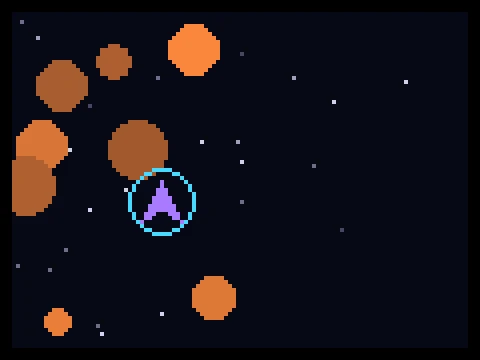
Survive an endless meteor field using momentum-based flight and a cooldown dash.
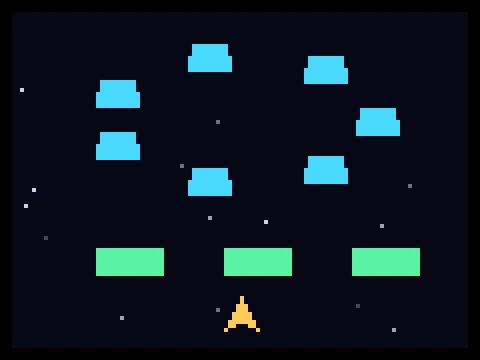
A formation-based space shooter with rotating enemy shapes and destructible shield cover.

A one-button tunnel flight where holding thrusts upward and releasing lets gravity pull you down.

Hold to pull your craft into a tighter orbit, release to let it drift wider — collect energy and dodge debris.
Most arcade genres give you direct positional control: you press left, you go left, you release, you stop. Space games historically replaced that with acceleration — you press left, you gain leftward velocity, and you keep it. That single change turns movement into a planning problem. Cosmic Dodge and Retro Orbit both lean hard on this: your position two seconds from now is decided by what you are pressing right now, and correcting a bad vector costs more than avoiding one.
A formation shooter is a pacing instrument. Pixel Invaders spawns enemies in shaped groups — wedges, rings, spirals, columns — and each shape creates a different threat pattern and a different optimal firing position. Learning to read the shape as it appears, and to move to the position that shape punishes least, is most of the skill ceiling in the genre.
Momentum flight, leading shots, formation reading, dash economy and orbital control.
Rate problems, difficulty plateaus, pacing a long run and recognising when a run is already lost.
No, and it is deliberately not. Pixel Invaders uses shaped formations that rotate and drift rather than a descending block, has its own power-up and scoring model, and uses original enemy designs. The name signals the genre; the game is its own design.
Retro Rocket is the most punishing on a first attempt because the tunnel gives you very little margin for a bad vector. Retro Orbit is the hardest to master because it asks for precise timing rather than precise aim.
Yes. Each one ships a touch control scheme suited to its mechanics — an analogue joystick for free-flight games, lateral buttons for the formation shooter, and a single tap for the thrust-based tunnel flight.
No. Every game on the site is single-player. There is no multiplayer server and no online component of any kind.
Fast, reflex-driven arcade games built around short levels, rising pressure and a score you want to beat.
7 gamesJumping, timing and precise movement — endless runners, tower climbs, collectible hunts and physics platformers.
5 gamesTop-down time trials, endless traffic runs and drift-scoring challenges built for short, repeatable sessions.
3 gamesReaction tests, mazes, timing puzzles, brick breaking and pattern recognition — thinking games that still run on a clock.
6 gamesEndless waves, base protection and threat prioritisation — how long can you hold out as the pressure compounds?
4 games