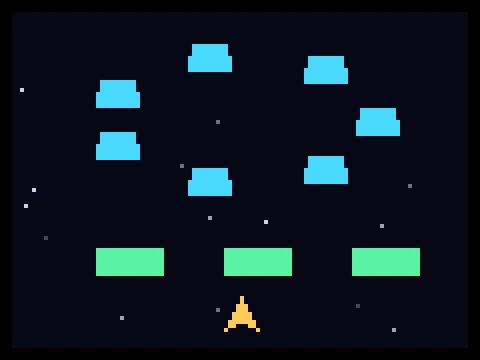
The defining feature of space arcade games is that most of them replace positional control with velocity control. You do not press left to go left — you press left to gain leftward velocity, and you keep it. This one change turns movement from execution into planning, and it is where essentially all the genre's difficulty lives.
Momentum flight
In Cosmic Dodge and Retro Orbit, your position two seconds from now is largely determined by what you are pressing now. Correcting a bad vector costs more than avoiding one.
The core technique
Short taps, not held keys. Held input builds velocity you will struggle to shed. Tap to nudge, drift, and correct. This feels slow and unresponsive at first and it is the only way to maintain a controllable velocity envelope.
There is no brake
Trying to hold still in a momentum game means fighting your own velocity, which produces oscillation. Accept that you are always moving and steer the drift rather than opposing it.
 Play it now
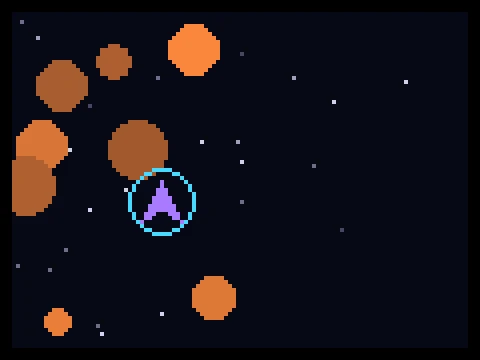
Cosmic Dodge
Survive an endless meteor field using momentum-based flight and a cooldown dash.
Dash economy
Cosmic Dodge's dash is the only tool that overrides momentum, and it is on a three-second cooldown. That scarcity makes it the game's entire strategic layer.
- Keep it in reserve. A dash spent on a comfortable escape is one you do not have four seconds later.
- Check your heading first. The dash travels in your current direction. Dashing while pointed at the dense side of the field is worse than not dashing.
- Watch the cooldown ring. It is rendered on the ship itself and it is the single most important HUD element in the game.
- Do not enter dense space without it. The bonus cores are placed in the densest region precisely to make this a real decision.
Leading shots
Projectiles take time to travel. Against anything moving laterally, aiming at where an enemy currently is means aiming at where it was.
The rule of thumb that works in Pixel Blaster and Pixel Invaders: lead by roughly the enemy's own width for each half-screen of distance. It is imprecise and it is far better than not leading at all.
Against Chasers specifically — enemies that accelerate toward you — lead further than feels right, because they are speeding up during your projectile's flight.
Reading formations
Pixel Invaders spawns enemies in shaped groups that rotate as rigid bodies. Each shape punishes a different position, and identifying the shape on spawn is worth more than any amount of fast shooting.
| Formation | Threat pattern | Where to be |
|---|---|---|
| Wedge | Fire concentrates at the apex | Attack from a flank |
| Ring | No safe outside angle, hollow centre | Get inside if you can reach it |
| Spiral | Unwinds toward you; safe zone moves | Stay mobile, follow the unwind |
| Columns | Regular lanes of fire | Sit in a lane gap |
| Diamond | Wide, shallow spread | Attack the narrow ends |
And the scoring point: the formation-clear bonus requires every enemy in the group. At wave 10 it is worth more than all the individual kills combined, so leaving a straggler on the far side is a large loss.
Orbital control
Retro Orbit uses a single input to control orbital radius, and it respects the relationship that matters: tighter orbits are faster.
- Lead your radius changes by about a second. Radius responds gradually.
- Dip inward for value. Inner rings are worth nearly seven times outer ones. Brief inward dips are the highest-value play.
- Vary deliberately. Debris density adapts to where you have been spending time, so camping a comfortable radius stops working within thirty seconds.
- Plan, do not react. At the inner radius your angular velocity is too high for reaction to be viable.
Thrust control
Retro Rocket is the purest version of the genre's core lesson: one button, applying acceleration rather than position.
New players hold the button, hit the ceiling, panic-release, hit the floor, and conclude the game is unfair. The actual technique is pulses of roughly 0.1 to 0.2 seconds that keep you oscillating narrowly around the tunnel's centre line.
If you are fighting the controls, you are treating acceleration as position. Pulse, drift, correct — in that order.
Key Takeaways
- Space games control velocity, not position. Short taps, never held keys.
- Dash and thrust are scarce resources with an economy — spend them deliberately.
- Lead your shots by roughly an enemy width per half-screen of distance.
- Identify formation shapes on spawn; each punishes a different position.
- In orbital games, vary your radius deliberately — camping triggers adaptive spawning.