Retro Racer
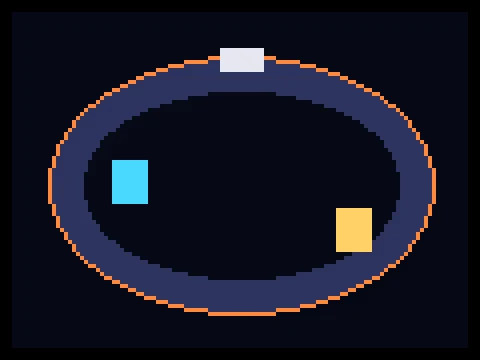
A top-down time-trial racer across three original circuits with checkpoints and best-time tracking.
Arrow keys or WASD
Arcade racing has never been about simulation. It is about a single, tight feedback loop: commit to a line, find out immediately whether it was right, adjust, repeat. The three racers here each isolate a different part of that loop — Retro Racer is about the racing line, Neon Highway is about reading traffic under rising speed, and Neon Drift is about holding a controlled slide for as long as your nerve lasts.
3 playable games in this category. Every one is complete — there are no placeholders.
A top-down time-trial racer across three original circuits with checkpoints and best-time tracking.

An endless lane-switching traffic dodger where near misses are the primary scoring mechanic.

A top-down drift-scoring challenge where points come from holding controlled slides.
A corner is fastest when you enter it wide, clip the inside at its midpoint, and exit wide again — because that path has the largest possible radius, and a larger radius means you can carry more speed through it. In Retro Racer this is not cosmetic: the handling model genuinely rewards it, and the difference between a line-aware lap and a naive one is several seconds over a full circuit.
Neon Highway pays you for passing traffic closely. That is not decoration — it is the mechanism that stops the optimal strategy from being “sit in the empty lane and wait”. By making the risky line the profitable one, the scoring system forces you into the traffic you would otherwise avoid, which is where the actual game is.
The racing line, braking points, grip thresholds, traffic reading and drift scoring.
Base rates, multipliers, risk premiums and bonuses — how to read a scoring system and exploit it.
No. They use simplified arcade handling models designed for keyboard and touch input in short sessions. Grip, drift and traction are tuned for readability and fun rather than physical accuracy.
Yes — your best time for each track is stored in your browser's localStorage on your own device. Nothing is uploaded and there is no global leaderboard.
Because three genuinely distinct racing designs were finished for launch, and padding the category with reskinned copies of the same game would make it worse, not better. The site architecture adds new games to a category without any structural change.
Yes. Retro Racer uses an analogue joystick, Neon Highway uses lane buttons, and Neon Drift uses steering buttons plus a dedicated drift button.
Fast, reflex-driven arcade games built around short levels, rising pressure and a score you want to beat.
7 gamesOriginal space shooters, meteor fields, tunnel flights and orbital challenges set against scrolling starfields.
5 gamesJumping, timing and precise movement — endless runners, tower climbs, collectible hunts and physics platformers.
5 gamesReaction tests, mazes, timing puzzles, brick breaking and pattern recognition — thinking games that still run on a clock.
6 gamesEndless waves, base protection and threat prioritisation — how long can you hold out as the pressure compounds?
4 games