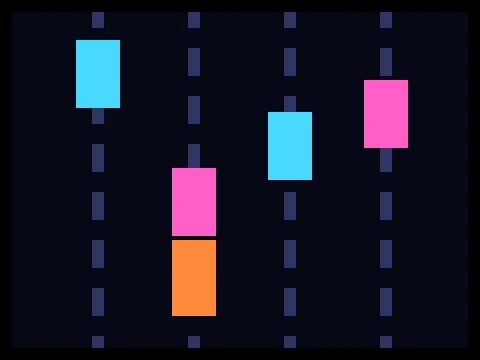
Neon Highway
An endless lane-switching traffic dodger where near misses are the primary scoring mechanic.
Left / Right arrows
Score as many drift points as possible in two minutes by holding long, high-angle slides without crashing.
Neon Drift inverts the usual racing objective. There is no lap time to beat and no finish line to reach. There is a two-minute clock and a scoring system that pays you for the one thing every other racing game punishes: losing traction on purpose.
A drift begins when your slip angle — the difference between where the car is pointing and where it is travelling — exceeds a threshold. While drifting, you accumulate points continuously at a rate proportional to both your angle and your speed. Ending a drift cleanly banks those points into your score. Crashing loses the entire un-banked amount, which is the mechanic that makes the game genuinely tense: a 40,000-point chain is a real thing to lose.
The tension is between angle and control. Steeper angles pay more but are closer to a spin. Faster drifts pay more but give you less time to correct. The optimal drift is neither the most spectacular nor the safest — it is the longest one you can hold, which usually means a moderate angle sustained around a long sweeping corner rather than a violent slide through a tight one.
Score as many drift points as possible in two minutes by holding long, high-angle slides without crashing.
| Input | Action |
|---|---|
| Up arrow or W | Throttle |
| Down arrow or S | Brake |
| Left / Right arrows or A / D | Steer |
| Space | Handbrake — breaks traction to initiate a drift |
| P or Escape | Pause and resume |
| R | Restart |
| Touch steering buttons + Drift button | Steer and handbrake (mobile) |
Every game on this site can be paused with P or Esc and restarted with R. Sound, retro screen effects and fullscreen are toggled from the buttons above the play area.
Points per second scale with the product of slip angle and speed. A 30-degree drift at high speed pays similarly to a 60-degree drift at half speed, but the former is far easier to hold. Understanding this is the main insight that separates a 100,000-point run from a 400,000-point one.
Drift points are held in an un-banked chain, shown separately from your score. They bank when your slip angle returns below the threshold under control. They are lost entirely on a crash or a full spin. The decision of when to stop a drift is the whole game.
The handbrake breaks traction instantly, which is the standard way to start a drift on a corner you entered too slowly. It costs speed, so a well-judged entry that drifts on throttle alone always scores more.
| Action | Value |
|---|---|
| Drifting | Points per second scaling with angle x speed |
| Chain banked cleanly | Full chain value added to score |
| Chain length bonus | +10% per 5 seconds of continuous drift |
| Crash or spin | Entire un-banked chain lost |
| Wall contact | 50% of the chain lost |
Your best result is saved in this browser only. Nothing is uploaded, and there is no global leaderboard — see the storage policy for exactly what is kept.
Two minutes. It is a fixed-duration score attack rather than a lap-based race.
Returning below the slip-angle threshold under control banks it. A crash or a full spin loses all of it. Wall contact loses half.
Because the risk-reward structure punishes the instinct the game encourages. It takes a while to learn to stop drifting while you are ahead.
One circuit, designed specifically for sustained drifting with long sweeping corners. A single well-designed track suits a score-attack format better than several mediocre ones.
Chosen by shared category, tags and difficulty — not padded with unrelated titles.
An endless lane-switching traffic dodger where near misses are the primary scoring mechanic.
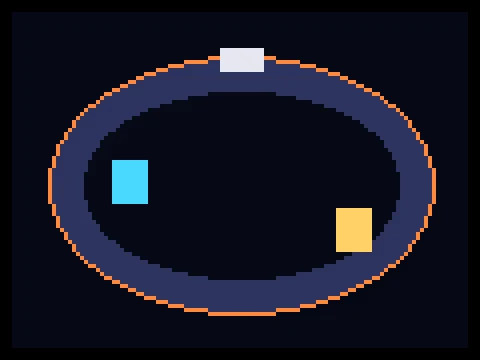
A top-down time-trial racer across three original circuits with checkpoints and best-time tracking.

Five arcade challenge types rotating in one continuous run, sharing a single score and life pool.

A growing-trail arena game with obstacles, wrap portals, speed tiers and combo scoring.
Base rates, multipliers, risk premiums and bonuses — how to read a scoring system and exploit it.
Nine concrete, testable methods — multiplier management, positioning, session length and error diagnosis.
The racing line, braking points, grip thresholds, traffic reading and drift scoring.