
Arcade Breaker
A brick-breaking game with six original layouts, armoured bricks and five power-ups.
Mouse, arrows or touch drag
Collect energy nodes to grow, avoid your own trail and the arena obstacles, and chain pickups for combo points.
The growing-tail format is one of the oldest ideas in games and it survives because its core tension is perfect: every point you score makes the game harder in a way you cannot undo. Neon Snake Arena keeps that and adds three things that change how it is actually played — arena obstacles, wrap portals, and a combo timer.
The obstacles are the biggest change. A standard open board means the danger is entirely self-inflicted; you only ever crash into your own trail. Adding fixed obstacle blocks means the board has permanent structure, which turns the game from pure self-management into a spatial routing problem. You are not just avoiding yourself — you are navigating a maze that you are progressively filling in.
The combo timer is what stops the optimal strategy from being slow and careful. Collecting a node within four seconds of the last one extends a chain and raises your multiplier. Playing safely means letting the chain lapse, which caps your score well below what an aggressive player achieves. As everywhere on this site, the cautious line is the low-scoring line.
Collect energy nodes to grow, avoid your own trail and the arena obstacles, and chain pickups for combo points.
| Input | Action |
|---|---|
| Arrow keys or W A S D | Change direction |
| P or Escape | Pause and resume |
| R | Restart |
| Touch D-pad | Change direction (mobile) |
Every game on this site can be paused with P or Esc and restarted with R. Sound, retro screen effects and fullscreen are toggled from the buttons above the play area.
Movement speed steps up at lengths 10, 20, 35 and 55 rather than rising continuously. Discrete tiers are easier to adapt to than a smooth ramp, and each tier change is a distinct moment where you have to recalibrate your input timing.
Four portals on the arena edges wrap you to the opposite side. They are a genuine tactical tool — escaping a closing trail through a portal is often the only survivable option — but the exit is not always clear, so using one is a calculated risk.
Collect a node within four seconds of the previous one to extend the chain. The multiplier rises every three links and caps at six. Node spawns are biased slightly away from your head, so maintaining a chain means committing to distance.
| Action | Value |
|---|---|
| Energy node collected | 100 points x combo multiplier |
| Combo chain extended | Multiplier rises every 3 links, cap x6 |
| Length milestone (every 10) | 500 point bonus |
| Portal traversal | 25 points |
Your best result is saved in this browser only. Nothing is uploaded, and there is no global leaderboard — see the storage policy for exactly what is kept.
Arena obstacles, wrap portals, discrete speed tiers and a combo timer. The growing-trail premise is a genre convention; everything built on top of it here is original.
No — in four discrete steps at lengths 10, 20, 35 and 55. Discrete tiers are easier to adapt to than a smooth ramp.
No. Contact with your own trail, an obstacle or the arena wall ends the run. Only the four portals let you cross an edge.
Length 40 is a solid result. Past 60 the arena is genuinely crowded and routing becomes the whole game.
Chosen by shared category, tags and difficulty — not padded with unrelated titles.
A brick-breaking game with six original layouts, armoured bricks and five power-ups.

Find keys, open gates and reach the exit before the timer expires — while patrolling hunters roam the maze.
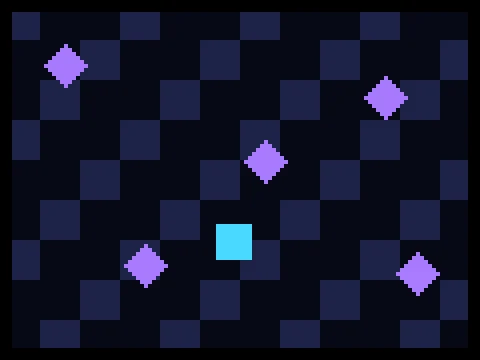
Route through a generated maze and collect every crystal before the countdown runs out.
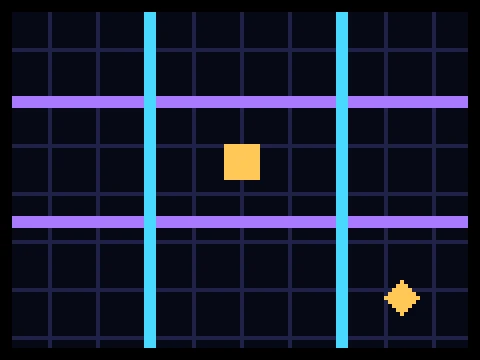
Move through a grid of sweeping laser barriers, collecting data nodes between the gaps.
Route planning under a clock, reading periodic hazards, and physics control.
What defines an arcade game, how the six main families differ, and how to get better at all of them.
A clear definition of the genre: origins, defining characteristics, and how browser games continue it.