“Practise more” is true and useless. This guide gives nine specific interventions, each of which you can apply in your next session and evaluate immediately. They are ordered by how much score they typically add for the effort involved.
1. Protect the multiplier above everything else
This is the single largest available improvement for most players, and it costs nothing but a change in priority.
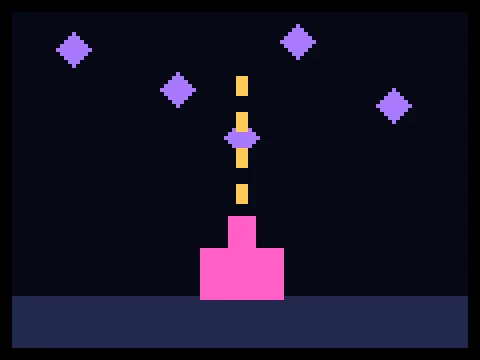
Work the arithmetic. In Pixel Blaster at an eight-times multiplier, a 100-point kill is worth 800. Taking a hit to reach one extra kill drops you to x1 and costs you roughly seven multiplied kills to rebuild. The trade is catastrophic and it is not close.
If an action risks your multiplier, it needs to be worth more than seven of the actions you are currently performing. It essentially never is.
2. Diagnose one error at a time
Play five runs and pay attention only to how each one ended. Do not think about score at all. Almost every player finds that four of the five ended the same way.
Common patterns and their usual causes:
| Symptom | Usual cause | Fix |
|---|---|---|
| Died in a corner | Retreating from threats rather than circling | Move laterally, not away |
| Died just after a hit | Fighting during invulnerability instead of relocating | Use the grace window to leave |
| Died reaching for a pickup | Treating pickups as objectives | Take only what is on your path |
| Died at a speed increase | Not anticipating a known threshold | Play conservatively across tier changes |
| Died early in a run | Warm-up cost | Accept the first run as a warm-up |
3. Play shorter sessions
Reflex accuracy degrades measurably with sustained focus, and it degrades before you notice it subjectively. The practical consequence is that runs eleven through twenty of a long session are usually worse than runs one through ten.
Three focused five-minute blocks with breaks between them will produce better results than one twenty-minute session, for the same total playtime. This is one of the few pieces of advice here that costs nothing at all to apply.
4. Fix your resting position
Every game has a default position that most players drift into, and in most games it is wrong.
- Bottom edge in vertical games feels safe and minimises reaction time. Move up.
- Screen centre in omnidirectional games looks safe and has the most incoming directions. Circle instead.
- Outer lanes in lane games halve your escape options. Stay central.
- Corners anywhere. There is no game on this site where a corner is a good place to be.
5. Find the risk premium and take it
If you are playing safely and your score has plateaued, the problem is strategic rather than mechanical. Every game here pays disproportionately for a specific risky behaviour, and playing without it caps your score regardless of execution quality.
 Play it now
Neon Drift
A top-down drift-scoring challenge where points come from holding controlled slides.
Neon Drift is the clearest case: the entire score comes from deliberately losing traction. A player driving cleanly can complete the two minutes without a single crash and score almost nothing.
6. Learn the generator, not the instance
Arcade games are systems, not levels. What repeats is not the exact configuration but the rules producing it — spawn patterns, obstacle groupings, wave compositions.
In Pixel Runner, the obstacle generator draws from a set of groupings. A player who recognises a grouping from its first element executes the whole sequence as one unit instead of reacting to three separate obstacles. That is a large difference in effective reaction time, achieved without reacting any faster.
7. Bank when you are ahead
In any game with an un-banked accumulation — Neon Drift's chain, Pixel Miner's ore, Retro Orbit's inner-radius run — there is a point where the expected value of continuing goes negative.
Most players never bank. The psychology is understandable: stopping feels like giving up value. But a 40,000-point chain lost is worth exactly zero, and a 25,000-point chain banked is worth 25,000.
8. Use the between-wave gaps
Every wave-based game gives you a breathing space, and most players spend it doing nothing.
- Reposition to a neutral spot with maximum escape options.
- Take your upgrade decision deliberately if the game has one.
- Look at what the next wave contains if it is previewed.
- Reset your grip and your posture.
In Pixel Defense specifically, the upgrade choice made in that gap has a larger effect on your final score than any individual wave's execution.
9. Play one game, not ten
Arcade skill is highly game-specific. Positioning knowledge in Pixel Blaster does not transfer to Retro Racer in any meaningful way.
If your goal is a high score, commit to one game for a week. If your goal is enjoyment, play whatever you like — but do not expect scores to move much while attention is spread across the library.
Twenty focused runs of a single game will typically produce a personal best well above what a hundred scattered runs across the library would.
Key Takeaways
- Protecting the multiplier is worth more than any improvement in raw execution.
- Diagnose one repeated error at a time rather than playing to beat the score.
- Short sessions beat long ones for the same total playtime.
- Corners, edges and screen centre are the three worst default positions.
- Find the risk premium — safe play caps your score no matter how well executed.