
Retro Tank Arena
A top-down arena tank battle with destructible cover, ricochet shots and enemy AI.
WASD + Mouse
Survive as many waves as possible and score as highly as you can before your three lives run out.
Pixel Blaster is the most direct expression of what this site is for. You have a ship in the middle of an open arena, enemies arrive from every edge, and the only two things you control are where you are and where you are pointing. There is no cover, no reload, no ammunition counter. What there is, instead, is a constant tension between the position that keeps you alive and the position that lets you kill things efficiently — and those are almost never the same position.
The game runs on waves. Each wave has a budget of enemies drawn from four original types, and the budget grows on a curve that rises quickly through the first five waves and then flattens. That shape is deliberate: it means the early game teaches you fast, and the late game is a war of attrition against a threat level that is high but stable. A skilled run does not end because the game suddenly became impossible; it ends because you made one positional mistake with no room left to recover.
Scoring is built around a combo multiplier. Every kill extends a short window, and chaining kills inside that window raises a multiplier that caps at eight. Taking a hit resets it to one. This creates the central risk decision of the game: the aggressive play that keeps your combo alive is also the play most likely to get you hit, and the multiplier is worth so much that protecting it usually beats reaching for one extra kill.
Survive as many waves as possible and score as highly as you can before your three lives run out.
| Input | Action |
|---|---|
| W A S D or Arrow keys | Move the ship |
| Mouse | Aim |
| Left mouse button or Space | Fire |
| P or Escape | Pause and resume |
| R | Restart the run |
| Touch joystick | Move (mobile) |
| Touch fire button | Fire in the direction you are moving (mobile) |
Every game on this site can be paused with P or Esc and restarted with R. Sound, retro screen effects and fullscreen are toggled from the buttons above the play area.
Drifters move slowly in a straight line and exist to be combo fuel. Chasers home in on your position and accelerate, so they must be dealt with before they cluster. Splitters break into two smaller, faster fragments when destroyed, which means killing one at close range is a mistake. Turrets stop at a fixed distance and fire aimed shots, and are the only enemy that punishes standing still.
Destroyed enemies occasionally drop one of three pickups: spread fire, rapid fire, or a shield that absorbs a single hit. They expire after eight seconds. The trap is that a pickup in a bad position is worth less than the combo you break getting to it — treat them as opportunistic, not as objectives.
After a hit you get a short grace window during which you cannot be damaged again. Use it to leave the situation that hurt you, not to keep fighting in it. The single largest difference between a two-minute run and a six-minute run is what the player does in the two seconds after losing a life.
| Action | Value |
|---|---|
| Drifter destroyed | 50 points |
| Chaser destroyed | 100 points |
| Splitter destroyed (parent) | 80 points |
| Splitter fragment destroyed | 40 points |
| Turret destroyed | 150 points |
| Wave cleared | 250 points x wave number |
| Combo multiplier | Applied to every kill, up to x8 |
Your best result is saved in this browser only. Nothing is uploaded, and there is no global leaderboard — see the storage policy for exactly what is kept.
It is endless. Waves keep generating with a rising enemy budget, so the run ends when you lose your third life rather than at a fixed finish line.
Yes. Space fires in your current facing direction, which is set by your movement, so the game is fully playable without a mouse — though mouse aiming gives you more control.
Clearing wave 8 puts you comfortably above a beginner run. Anything past wave 15 means you have the combo management and positioning working together.
No. Picking up a second weapon power-up replaces the first and resets the timer. The shield is the exception — it is tracked separately and can be held alongside a weapon power-up.
Chosen by shared category, tags and difficulty — not padded with unrelated titles.
A top-down arena tank battle with destructible cover, ricochet shots and enemy AI.
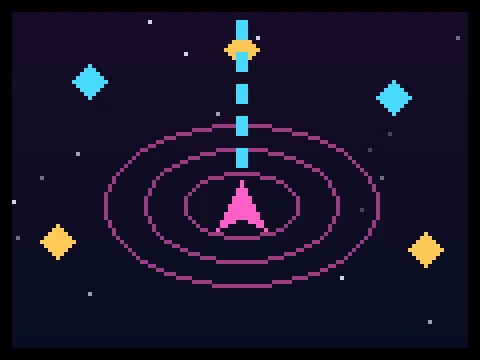
The flagship game: six stages combining shooting, dodging, collecting, platforming and timing, with bonus rounds.
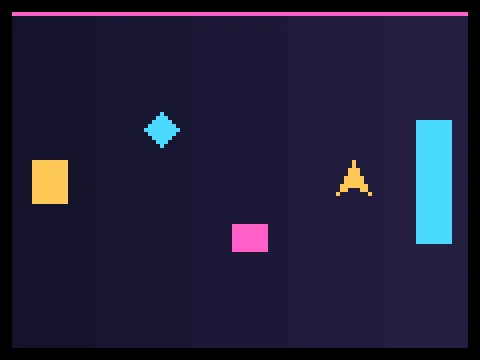
Five arcade challenge types rotating in one continuous run, sharing a single score and life pool.
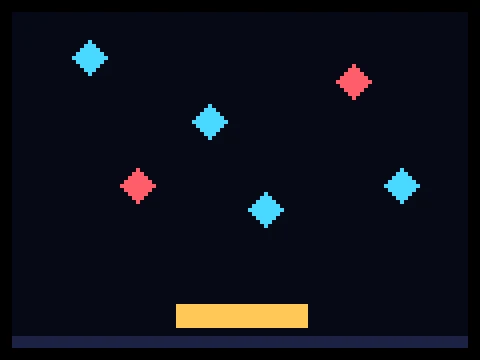
A 90-second round of catching valuable falling objects while avoiding the hazards that reset your streak.
What defines an arcade game, how the six main families differ, and how to get better at all of them.
A clear definition of the genre: origins, defining characteristics, and how browser games continue it.
Base rates, multipliers, risk premiums and bonuses — how to read a scoring system and exploit it.