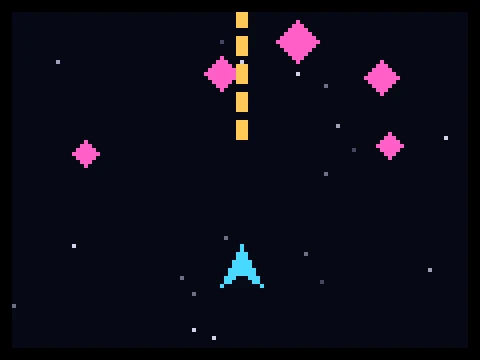
Pixel Blaster
A twin-stick arcade shooter where you move with WASD and aim with the mouse against escalating enemy waves.
WASD + Mouse
Play Free Retro Arcade Games Online
Play free retro-inspired arcade games online. Test your reflexes, chase high scores, dodge obstacles, defend your base, collect points and master original arcade challenges — all in your browser, with no download and no account.

An editor-selected cross-section of the library — one or two from each category, chosen to show the range rather than to rank them.
A twin-stick arcade shooter where you move with WASD and aim with the mouse against escalating enemy waves.
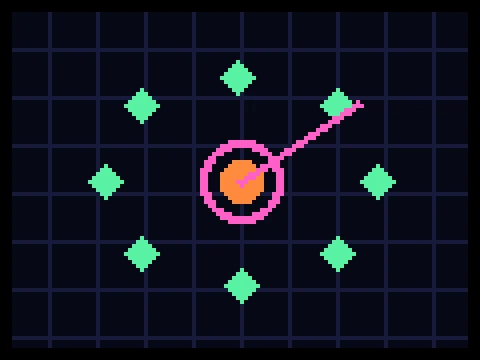
Rotate a cannon around a central core and hold back waves of converging enemies.
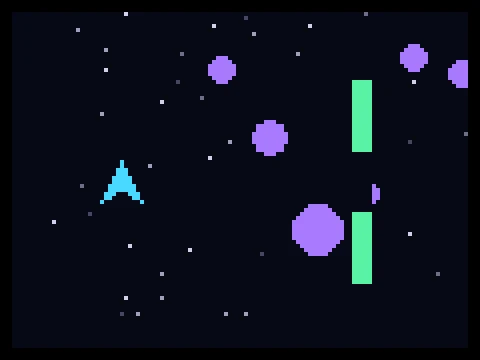
Steer a small starship through a scrolling hazard field of meteors, gates and energy barriers.
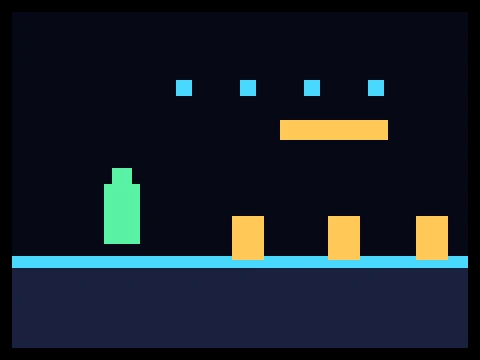
An endless side-scrolling runner built around two inputs: jump and slide.
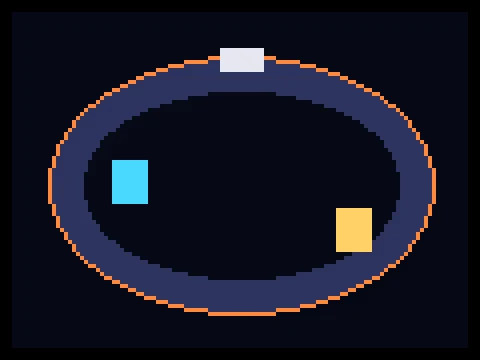
A top-down time-trial racer across three original circuits with checkpoints and best-time tracking.
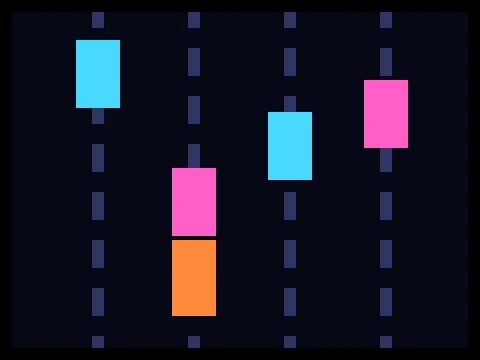
An endless lane-switching traffic dodger where near misses are the primary scoring mechanic.
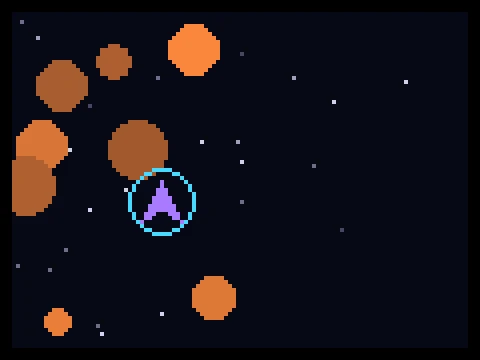
Survive an endless meteor field using momentum-based flight and a cooldown dash.

Defend a base from escalating waves, choosing one upgrade between each wave.
Games you have played on this device recently.
Six families of arcade game, each demanding a genuinely different skill.
Fast, reflex-driven arcade games built around short levels, rising pressure and a score you want to beat.
7 gamesOriginal space shooters, meteor fields, tunnel flights and orbital challenges set against scrolling starfields.
5 gamesJumping, timing and precise movement — endless runners, tower climbs, collectible hunts and physics platformers.
5 gamesTop-down time trials, endless traffic runs and drift-scoring challenges built for short, repeatable sessions.
3 gamesReaction tests, mazes, timing puzzles, brick breaking and pattern recognition — thinking games that still run on a clock.
6 gamesEndless waves, base protection and threat prioritisation — how long can you hold out as the pressure compounds?
4 gamesOrdered by the release date recorded in each game's metadata.

The flagship game: six stages combining shooting, dodging, collecting, platforming and timing, with bonus rounds.

Five arcade challenge types rotating in one continuous run, sharing a single score and life pool.

Hold to pull your craft into a tighter orbit, release to let it drift wider — collect energy and dodge debris.

A draw-on-the-signal reaction duel against a ladder of AI opponents with rising reaction speeds.
What the format actually does well, and how these games are built.
Arcade games are built on a design philosophy rather than a time period: short runs that end in failure, a score that makes two runs comparable, and difficulty that climbs until you lose. That structure produces something unusual — a game you understand in ten seconds and are still improving at an hour later.
Every game here is written for that structure. Sessions run two to five minutes. Controls are small enough to learn immediately. Difficulty rises on a curve that teaches quickly and then holds, so a long run tests consistency rather than punishing you for lasting.
They also happen to fit how time is actually available. A three-minute game with no install, no account and no save file is playable in the gaps of a day, and being interrupted costs you nothing.
How arcade scoring, difficulty and mechanics actually work — written from the code that implements them.
What defines an arcade game, how the six main families differ, and how to get better at all of them.
A clear definition of the genre: origins, defining characteristics, and how browser games continue it.
Base rates, multipliers, risk premiums and bonuses — how to read a scoring system and exploit it.
Nine concrete, testable methods — multiplier management, positioning, session length and error diagnosis.
Which games to start with, the four habits that matter most, and what to expect in your first hour.
Rate problems, difficulty plateaus, pacing a long run and recognising when a run is already lost.
Yes. All 30 games are free to play with no account, no download, no trial and no in-game purchases. The site is supported by display advertising, which is kept out of the gameplay area.
No. Every game is an HTML5 game running directly in your browser tab. There is no plugin, no installer and nothing to download.
Yes. Every game has a touch control scheme designed for its specific mechanics — an analogue joystick for free-flight games, lane buttons for the traffic game, a jump and slide pair for the runner, and direct dragging for the paddle games.
Your best score for each game is saved in your own browser using localStorage. It is not uploaded anywhere, it is not shared between devices or browsers, and clearing your browser data will remove it. There is no global leaderboard because we do not run a server that could hold one.
No. Every game here is an original design created for this site. They use the structural ideas of arcade gaming — score attack, rising difficulty, short runs — but no commercial game's characters, artwork, sounds, level layouts or trademarked names are reproduced anywhere.
Starship Sprint. It has direct controls, one thing to do, and no scoring system competing for your attention while you learn. After that, Pixel Runner and then Pixel Blaster.
High Score Hero and Ultimate Retro Arcade are both rated Expert. High Score Hero demands competence across five different challenge types; Ultimate Retro Arcade is a six-stage progression with a boss-style finale.
No. There are no accounts, no sign-ups and no personal data collection. The site stores your scores, favourites and preferences in your own browser, and nothing else. Full detail is in the cookie and storage policy.
Only if the page is already open. There is no offline caching, so a game will not load fresh without a connection. We do not claim offline support because we have not implemented it.
The site launched with 30 games and the architecture supports adding more without structural change. Anything new appears on the new games page with a real release date in its metadata.