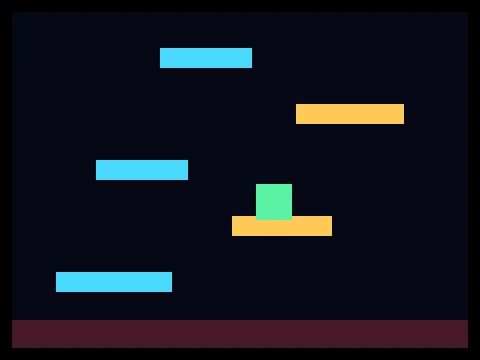
Arcade Tower
Climb an endless tower of moving platforms while a rising hazard floor forces you upward.
Arrow keys + Space
Run as far as possible, clearing obstacles with well-timed jumps and slides.
Pixel Runner has exactly two verbs. You jump, or you slide. Everything the game does with those two inputs — and it does a surprising amount — comes from varying the shape and spacing of what it puts in front of you. A low block wants a jump. A high beam wants a slide. A block followed immediately by a beam wants a jump that lands early enough to slide, which is a genuinely different skill from either input alone.
The jump is variable height: a tap gives you a short hop, holding gives you a full arc. This is the single most important thing to internalise, because the obstacle generator produces sequences that are only clearable with the short hop. A player who only knows the full jump will hit a ceiling — literally — around the ninety second mark, when the generator starts placing hazards above landing points.
Speed increases with distance on a curve that flattens around three minutes, which means the very long runs are not about ever-faster reactions. They are about pattern recognition: the generator draws from a set of obstacle groupings, and once you recognise a grouping from its first element, you can execute the whole sequence without thinking about the individual pieces.
Run as far as possible, clearing obstacles with well-timed jumps and slides.
| Input | Action |
|---|---|
| Space, Up arrow or W | Jump (hold for height) |
| Down arrow or S | Slide |
| P or Escape | Pause and resume |
| R | Restart |
| Touch Jump button | Jump (mobile) |
| Touch Slide button | Slide (mobile) |
Every game on this site can be paused with P or Esc and restarted with R. Sound, retro screen effects and fullscreen are toggled from the buttons above the play area.
Releasing the jump input cuts your upward velocity immediately, so a brief tap produces a hop roughly a third the height of a full held jump, and everything in between is available. Both extremes are needed: sequences with a low ceiling directly after a block are unclearable with the full arc, and the generator produces them from the first difficulty tier onward.
You keep the ability to jump for a short window after running off a ledge, and a jump pressed just before landing is queued rather than dropped. Both are standard modern platformer affordances and both are here for the same reason: they remove failures that feel like input problems rather than skill problems.
A slide lasts a fixed 0.45 seconds and cannot be cancelled. That fixed duration is a real constraint — sliding early under a long beam means standing up inside it. The correct slide is always later than it feels.
| Action | Value |
|---|---|
| Distance | 12 points per second |
| Obstacle cleared | 25 points |
| Coin collected | 50 points, multiplied by your combo |
Your best result is saved in this browser only. Nothing is uploaded, and there is no global leaderboard — see the storage policy for exactly what is kept.
Effectively yes. The speed curve flattens around the three-minute mark, so very long runs are played at a high but stable speed.
No. Coins are pure score with no penalty for skipping them. They are placed to tempt you into bad jumps, not to punish you for ignoring them.
No. One jump per grounded contact, plus the coyote-time window. Adding a double jump would remove most of the game's timing pressure.
Two minutes is a solid intermediate run. Five minutes means you are reading obstacle groupings rather than individual obstacles.
Chosen by shared category, tags and difficulty — not padded with unrelated titles.
Climb an endless tower of moving platforms while a rising hazard floor forces you upward.
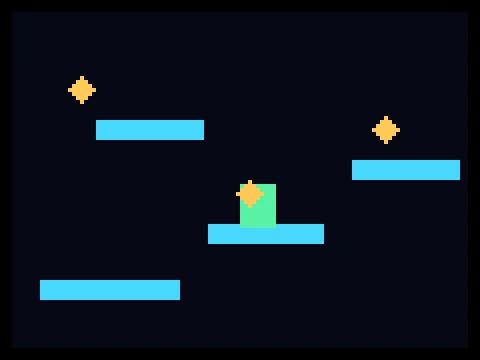
A stage-based platformer with moving platforms, collectible gems and patrolling hazards.

Dig downward through underground layers, collecting ore while managing oxygen and avoiding cave-ins.

A physics-driven platformer where you roll and bounce a ball through ten stages of ramps and hazards.
A clear definition of the genre: origins, defining characteristics, and how browser games continue it.
Which games to start with, the four habits that matter most, and what to expect in your first hour.
Jump arcs, variable height, coyote time, moving platforms and route planning.