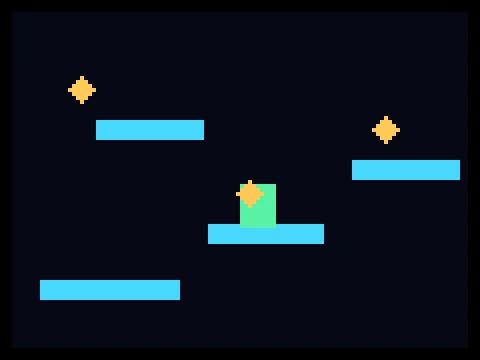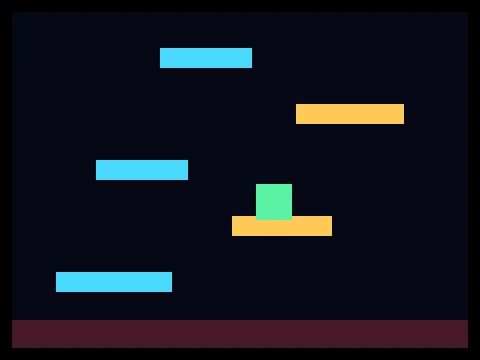
A platformer's difficulty is almost entirely a function of how accurately you can predict where you will land. Because gravity and jump velocity are constants, every jump you will ever make in a given game traces one of a small family of curves. Expert players are not reacting faster — they have internalised those curves and are choosing launch points rather than landing points.
The jump arc is the whole game
Three constants define every jump: gravity, initial upward velocity, and horizontal speed. Combined, they produce a parabola whose shape never changes.
The practical technique that follows: aim with your launch point, not with your landing point. You cannot steer the arc meaningfully once you are in it — partial air control lets you adjust, not rescue. The decision that matters is where and when you leave the ground.
In Pixel Jumper, stand on a platform and jump repeatedly without moving. Watch exactly how high and how far you go. Two minutes of this makes every subsequent jump a known quantity.
Variable jump height
Every platformer on this site uses hold-for-height jumping. Tapping produces a short hop, holding produces the full arc.
Most new players never discover the short hop, and it roughly doubles the number of sequences they can clear. In Pixel Runner specifically, the obstacle generator produces groupings that are only clearable with a short hop — a low block immediately followed by a low ceiling. A player who only knows the full jump hits a hard wall around ninety seconds.
 Play it now
Pixel Runner
An endless side-scrolling runner built around two inputs: jump and slide.
Coyote time and jump buffering
Two affordances that exist to remove failures that feel like input problems rather than skill problems.
- Coyote time. You keep the ability to jump for a short window after running off a ledge. Without it, jumps at the exact edge of a platform fail in a way that feels arbitrary.
- Jump buffering. A jump pressed slightly before you land is queued rather than discarded. Without it, chained jumps require frame-perfect timing.
Both are on in every platformer here. Knowing they exist lets you use them: you can deliberately jump slightly late off a ledge and slightly early on a landing, which widens your effective timing window in both directions.
Moving platforms
A moving platform converts a spatial problem into a temporal one. The gap does not change; the window does.
The core rule
Jump onto an approaching platform, not a departing one. An approaching platform gives you landing margin in both directions — if you are early it comes to you, if you are late you still land on it. A departing platform gives you a single correct moment.
Reading the cycle
Platforms in Pixel Jumper run on independent sine cycles with different periods and phase offsets. They are never synchronised, which is deliberate: it means routing requires you to catch one at a specific point in its cycle, and waiting for it costs you time on the others.
Watch one full cycle before committing. Three seconds of observation saves two failed attempts.
Route planning versus reaction
Platformers split into two structures and they demand different mental modes.
| Structure | Example here | Mental mode |
|---|---|---|
| Single screen, fully visible | Pixel Jumper, Retro Ball Challenge | Plan the whole route before moving |
| Scrolling, partially visible | Pixel Runner, Arcade Tower | Read ahead, execute continuously |
In visible-screen platformers, moving before planning is the primary cause of failure. In scrolling platformers, planning is impossible beyond a few seconds and the skill is maintaining a continuous read of what is arriving.
Momentum platformers
Retro Ball Challenge replaces the precise character controller with rolling physics, which changes the discipline entirely.
- Inputs must be earlier, because acceleration takes time to become position.
- Overshooting is expensive — reversing direction takes longer than starting from rest.
- Ramp launches depend on arrival speed, so the approach matters more than the jump.
- The jump is weak by design and cannot substitute for a correct approach.
The universal advice for momentum platformers: tap, do not hold. Build speed in increments and coast. Holding a direction key guarantees overshoot.
The forced-pace platformer
Arcade Tower removes the ability to stop and think by rising a hazard floor behind you. This inverts the usual platformer calculus: the safe route that takes four extra seconds is not safe, because the floor gained four seconds of height.
In a forced-pace platformer the expected value of the aggressive route is genuinely higher. Hesitation has a guaranteed cost, which is not true anywhere else in the genre.
Key Takeaways
- Aim with your launch point — you cannot steer an arc once you are in it.
- Learn the short hop. It roughly doubles the sequences you can clear.
- Coyote time and jump buffering let you jump slightly late off ledges and early on landings.
- Jump onto approaching platforms, never departing ones.
- In momentum platformers, tap rather than hold; in forced-pace ones, take the aggressive route.