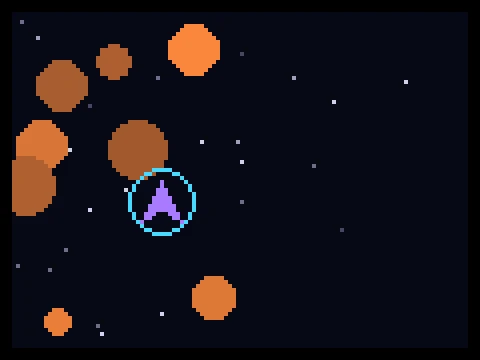
Cosmic Dodge
Survive an endless meteor field using momentum-based flight and a cooldown dash.
WASD + Shift to dash
Fly as far as you can without collision, collecting energy cells to raise your score multiplier.
Starship Sprint is the gentlest entry point on the site and the one most people should start with. There is no shooting, no resource management and no combo system to protect. There is a ship, a scrolling field of hazards, and the single question of whether you can find a path through. That simplicity is the point — it lets the game teach spatial anticipation without any other skill competing for your attention.
The hazard field is generated from three elements that behave differently. Meteors tumble in at varied angles and are the most predictable threat. Energy gates present a wall with a single moving gap, so they are a timing problem rather than a positioning one. Barriers sweep laterally across the full width of the screen and force you to commit to a side well before they arrive. The generator interleaves them so you rarely face two of the same type in a row.
Speed rises continuously with distance, which means the game is really a test of how far ahead you are looking. At low speed you can react to a hazard as it enters the screen. By the two minute mark you cannot — you have to be reading the top of the screen and planning your lane two hazards in advance. Every player hits this wall, and getting past it is the moment the game opens up.
Fly as far as you can without collision, collecting energy cells to raise your score multiplier.
| Input | Action |
|---|---|
| Arrow keys or W A S D | Steer the ship in all four directions |
| P or Escape | Pause and resume |
| R | Restart |
| Touch joystick | Steer (mobile) |
Every game on this site can be paused with P or Esc and restarted with R. Sound, retro screen effects and fullscreen are toggled from the buttons above the play area.
Blue energy cells drift down the field and raise your score multiplier by one, to a maximum of five. The multiplier decays after six seconds without a pickup, so it rewards a continuous collection line rather than opportunistic grabs. Cells are deliberately placed near hazards — the multiplier is meant to cost you something.
Unlike the other space games here, Starship Sprint gives you direct positional control with no inertia. Release the key and you stop immediately. This is what makes it the beginner's game: you can always take the input back.
Passing within a ship's width of a hazard without touching it awards a small bonus and a brief screen pulse. It exists to teach you that the safe-looking wide path is not the scoring path, and to make close flying feel deliberate rather than lucky.
| Action | Value |
|---|---|
| Distance travelled | 10 points per second, multiplied |
| Energy cell collected | 100 points x multiplier, and +1 to the multiplier |
| Near miss | 25 points |
| Gate passed cleanly | 150 points |
| Multiplier | Up to x5, decays one step every 6 seconds without a cell |
Your best result is saved in this browser only. Nothing is uploaded, and there is no global leaderboard — see the storage policy for exactly what is kept.
No, it is endless. Speed rises indefinitely and the run ends on your first collision.
One. A single collision ends the run. This is what keeps the tension high in a game with no other pressure systems.
It decays six seconds after your last energy cell. Keeping it at five requires a near-continuous collection line, which is the game's real challenge.
It is the most approachable game on the site — one input, no violence beyond abstract shapes colliding, and no time pressure beyond the speed ramp.
Chosen by shared category, tags and difficulty — not padded with unrelated titles.
Survive an endless meteor field using momentum-based flight and a cooldown dash.
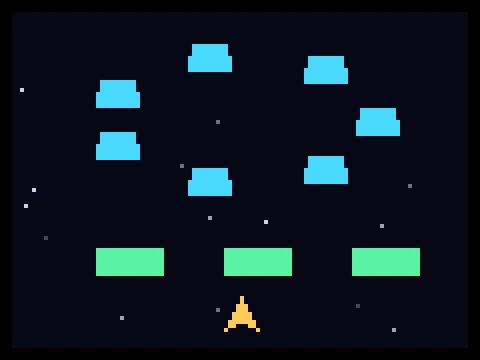
A formation-based space shooter with rotating enemy shapes and destructible shield cover.
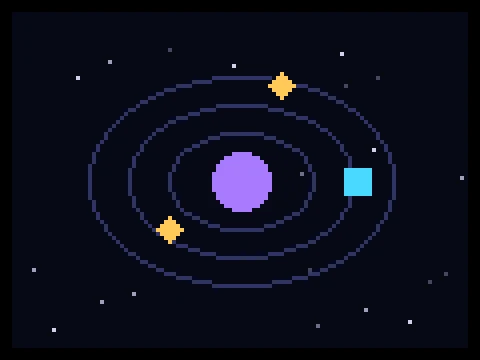
Hold to pull your craft into a tighter orbit, release to let it drift wider — collect energy and dodge debris.

A one-button tunnel flight where holding thrusts upward and releasing lets gravity pull you down.
What defines an arcade game, how the six main families differ, and how to get better at all of them.
Session length, feedback clarity and skill expression — the structural reasons the format endures.
The one-more-run loop, near-miss psychology, self-attributed failure — and keeping it healthy.