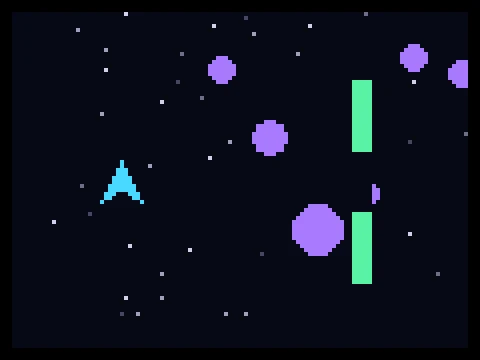
Starship Sprint
Steer a small starship through a scrolling hazard field of meteors, gates and energy barriers.
Arrow keys or WASD
Stay alive as long as possible in a filling meteor field, using your dash to escape when position alone is not enough.
Cosmic Dodge is the hardest survival game on the site and it earns that by taking away the thing every other dodging game gives you: direct positional control. Your ship has momentum. Pressing a direction accelerates you; releasing it does not stop you. Where you will be in two seconds is already largely determined by what you are doing now, and correcting a bad vector takes longer than avoiding one.
The dash is the answer to that constraint, and it is deliberately scarce. It gives you a short burst of high-speed movement with brief invulnerability, on a three-second cooldown. Because it is the only way to defeat your own momentum, the entire strategic layer of the game is about dash economy: when to spend it, and — much harder — when to accept a bad position rather than spend it, because you will need it in four seconds.
The meteor field fills continuously. Meteors do not despawn until they leave the field, and the spawn rate rises, which means the available safe space shrinks monotonically. There is no point at which the field opens back up. The game is a slow squeeze, and the score is a measure of how long you managed the squeeze before it closed.
Stay alive as long as possible in a filling meteor field, using your dash to escape when position alone is not enough.
| Input | Action |
|---|---|
| W A S D or Arrow keys | Thrust (accelerates, does not directly set position) |
| Shift or Space | Dash in your current direction of travel |
| P or Escape | Pause and resume |
| R | Restart |
| Touch joystick | Thrust (mobile) |
| Touch Dash button | Dash (mobile) |
Every game on this site can be paused with P or Esc and restarted with R. Sound, retro screen effects and fullscreen are toggled from the buttons above the play area.
Thrust accelerates, drag decelerates slowly, and there is no brake. Short corrective taps keep your velocity inside a controllable envelope. Held input builds speed you will struggle to shed before the next hazard.
Dash gives you roughly 0.2 seconds of high-speed travel and invulnerability, then a three-second cooldown. It is the only tool that overrides momentum. The cooldown ring around your ship is the single most important HUD element in the game.
Bonus cores spawn in the densest part of the field, not the safest. Collecting one grants a large score bonus and shortens your dash cooldown by half a second for ten seconds. It is a genuine risk-reward decision rather than free points.
| Action | Value |
|---|---|
| Survival | 20 points per second |
| Near miss | 40 points |
| Bonus core collected | 500 points and a 10-second dash cooldown reduction |
| Dashing straight through a meteor while invulnerable | 150 point precision bonus |
Your best result is saved in this browser only. Nothing is uploaded, and there is no global leaderboard — see the storage policy for exactly what is kept.
Because momentum flight removes the ability to take an input back. Every other dodging game on the site lets you stop; this one does not, and that single change roughly doubles the skill floor.
Three seconds, reduced to two and a half for ten seconds after collecting a bonus core. The ring around your ship shows the current state.
No. Meteors persist until they leave the playfield and the spawn rate only rises. The squeeze is monotonic by design.
Ninety seconds is a strong intermediate result. Past three minutes means your dash economy is genuinely working.
Chosen by shared category, tags and difficulty — not padded with unrelated titles.
Steer a small starship through a scrolling hazard field of meteors, gates and energy barriers.

Hold to pull your craft into a tighter orbit, release to let it drift wider — collect energy and dodge debris.

A one-button tunnel flight where holding thrusts upward and releasing lets gravity pull you down.
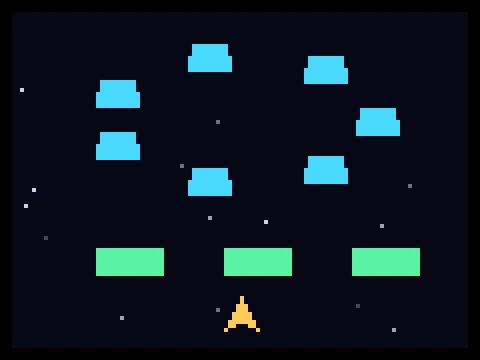
A formation-based space shooter with rotating enemy shapes and destructible shield cover.
The three curve shapes, what separates hard from unfair, and how difficulty is actually tuned.
Rate problems, difficulty plateaus, pacing a long run and recognising when a run is already lost.
Momentum flight, leading shots, formation reading, dash economy and orbital control.