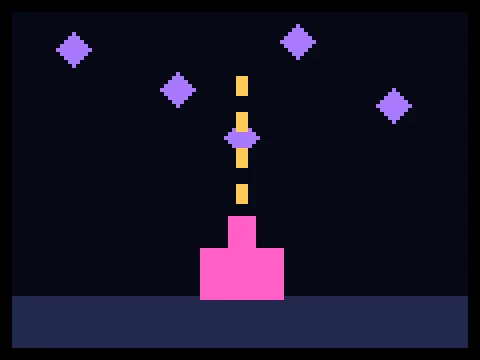
Pixel Defense
Defend a base from escalating waves, choosing one upgrade between each wave.
Mouse or touch
Protect the core. Rotate to intercept incoming enemies before they reach it, and survive as many waves as you can.
Neon Defender takes the wave-defence idea and strips it down to one decision repeated under pressure: which direction do you point? Your cannon orbits a central core at a fixed radius. You cannot move it closer or further out. Enemies converge on the core from every angle, and your only tool is angular position — which means every shot you take is also a decision about which part of the perimeter you are choosing to leave undefended.
That constraint is what gives the game its shape. In a free-movement shooter you can outrun a bad decision. Here you cannot: the cost of rotating 180 degrees to answer a threat behind you is that everything in front of you gets a free approach. Good play is therefore anticipatory. You watch the spawn ring, you identify where the next cluster is forming, and you are already turning before it commits.
The core has five health points and does not regenerate between waves. That single design choice makes the game about consistency rather than heroics — a run where you lose one health point per wave ends at wave five regardless of how well you shoot. Long runs come from waves where nothing gets through at all.
Protect the core. Rotate to intercept incoming enemies before they reach it, and survive as many waves as you can.
| Input | Action |
|---|---|
| Left / Right arrows or A / D | Rotate the cannon |
| Space or Up arrow | Fire |
| P or Escape | Pause and resume |
| R | Restart |
| Touch left / right buttons | Rotate (mobile) |
| Touch A button | Fire (mobile) |
Every game on this site can be paused with P or Esc and restarted with R. Sound, retro screen effects and fullscreen are toggled from the buttons above the play area.
Your cannon accelerates into a turn and decelerates out of it. Holding a direction key across a wide arc builds speed you then have to shed, and new players consistently overshoot the target angle. Short taps give you precise angular control; held keys give you fast repositioning. Knowing which you need is most of the skill.
Runners move straight at the core at a constant speed. Weavers oscillate laterally as they approach, so a shot aimed at their current position usually misses. Armoured units take three hits and move slowly, functioning as a timer you must budget around. Every wave mixes them, and the mix is what makes each wave feel different.
Consecutive kills without letting anything reach the core build a multiplier shown as a ring around the core itself. It resets the instant the core takes damage, which means the scoring system and the survival system are the same system — you are never trading one against the other.
| Action | Value |
|---|---|
| Runner destroyed | 60 points |
| Weaver destroyed | 110 points |
| Armoured unit destroyed | 220 points |
| Wave survived with no core damage | 500 points bonus |
| Combo multiplier | Up to x8, resets on core damage |
Your best result is saved in this browser only. Nothing is uploaded, and there is no global leaderboard — see the storage policy for exactly what is kept.
No. The five health points are all you get for the entire run. This is intentional — it makes clean waves worth far more than efficient damage trading.
No. The fixed radius is the central constraint of the design. Everything interesting about the game comes from not being able to reposition.
Wave 8 is a solid intermediate result. Wave 15 and beyond requires reading spawn clusters before they commit rather than reacting to them.
Yes, a short one. It is fast enough that continuous fire feels smooth, but slow enough that you cannot brute-force an Armoured unit instantly at close range.
Chosen by shared category, tags and difficulty — not padded with unrelated titles.
Defend a base from escalating waves, choosing one upgrade between each wave.

Defend six cities from incoming objects when you cannot possibly intercept them all.

An endless arena survival game where enemies never stop arriving and never despawn.
A growing-trail arena game with obstacles, wrap portals, speed tiers and combo scoring.
Lives, waves, power-ups, invulnerability and spawn logic — the standard building blocks explained.
Threat triage, rate management, upgrade ordering, cluster control and wave gaps.
What defines an arcade game, how the six main families differ, and how to get better at all of them.