
Pixel Maze
Find keys, open gates and reach the exit before the timer expires — while patrolling hunters roam the maze.
Arrow keys or WASD
Collect data nodes while timing your movement through moving laser barriers. One touch ends the run.
Laser Grid is a pure timing game wearing a puzzle game's clothes. The playfield is a grid crossed by laser barriers that sweep on fixed cycles — horizontal, vertical, and in later stages rotating. Data nodes appear in cells you have to reach. Touching any laser ends the run immediately. There is no health, no shield and no second chance.
What makes it a skill game rather than a reflex test is that the lasers are entirely predictable. Every barrier runs on a period you can count. Nothing is random. This means every death is, in principle, avoidable — and it means the correct way to play is not to react to a laser but to have already decided, three seconds ago, that you would be in this cell at this moment.
Difficulty rises by adding barriers rather than by speeding them up. Stage one has two. By stage six there are seven, on five different periods, and the safe windows are formed by the intersection of all of them. That intersection is where the game lives — the moment when four independent cycles briefly align to open a path across the board.
Collect data nodes while timing your movement through moving laser barriers. One touch ends the run.
| Input | Action |
|---|---|
| Arrow keys or W A S D | Move one cell in that direction |
| P or Escape | Pause and resume |
| R | Restart |
| Touch D-pad | Move (mobile) |
Every game on this site can be paused with P or Esc and restarted with R. Sound, retro screen effects and fullscreen are toggled from the buttons above the play area.
Each barrier runs on a fixed period drawn from a set between 1.9 and 4.1 seconds, and is active for about a third of it. The periods are deliberately non-harmonic, so the combined pattern has a long repeat and never settles into a trivially memorised loop.
Nodes spawn one at a time in a random reachable cell. Collecting one spawns the next and adds time to a countdown. Letting the countdown expire ends the run, so pure caution is not a viable strategy — you must move.
Every barrier flashes for 0.4 seconds before it activates. That window is the game's core fairness guarantee: nothing kills you without telling you first.
| Action | Value |
|---|---|
| Data node collected | 200 points x stage number |
| Node collected with under 2 seconds remaining | 100 point pressure bonus |
| Stage cleared (8 nodes) | 1,000 points |
| Cell crossed during a warning flash | 25 point precision bonus |
Your best result is saved in this browser only. Nothing is uploaded, and there is no global leaderboard — see the storage policy for exactly what is kept.
The node positions are random. The barriers are not — every one runs on a fixed, countable cycle, which is what makes the game solvable rather than luck-based. A barrier is also never placed on the cell you are standing on when a stage begins, and you get a one-second grace window at the start of each stage.
Six. Each adds a barrier rather than increasing speed, so the difficulty comes from pattern complexity rather than reaction time.
You almost certainly moved during the last frames of the warning flash into a cell the beam was about to occupy. The flash is a warning, not a safety guarantee for the whole cell.
No. One touch ends the run. This is why the warning flash exists — the game is strict, so it must also be completely legible.
Chosen by shared category, tags and difficulty — not padded with unrelated titles.
Find keys, open gates and reach the exit before the timer expires — while patrolling hunters roam the maze.
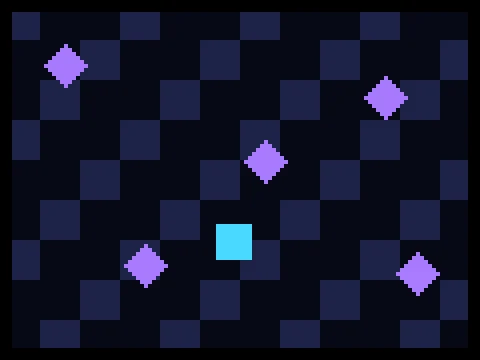
Route through a generated maze and collect every crystal before the countdown runs out.
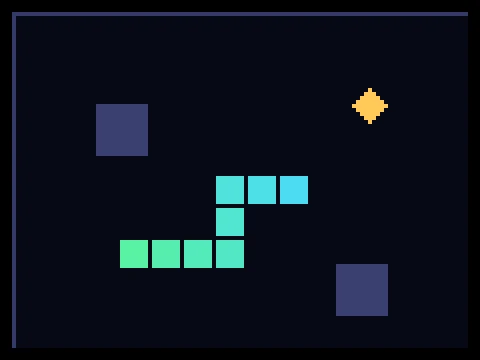
A growing-trail arena game with obstacles, wrap portals, speed tiers and combo scoring.

A brick-breaking game with six original layouts, armoured bricks and five power-ups.
Route planning under a clock, reading periodic hazards, and physics control.
What defines an arcade game, how the six main families differ, and how to get better at all of them.
A clear definition of the genre: origins, defining characteristics, and how browser games continue it.