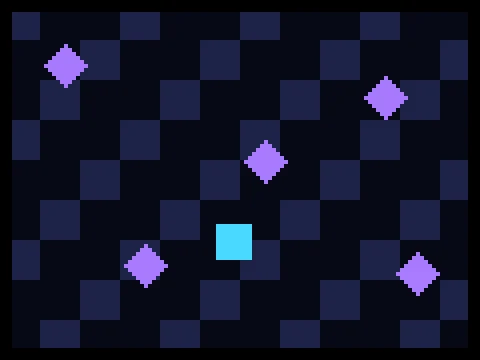
Crystal Collector
Route through a generated maze and collect every crystal before the countdown runs out.
Arrow keys or WASD
Collect every key, unlock the exit gate and escape before the countdown reaches zero.
Pixel Maze is Crystal Collector's harder sibling. It shares the generated-maze foundation but adds two things that change the problem entirely: locked gates, and hunters that move.
The gates impose an ordering constraint. You cannot simply route to every objective in whatever sequence is shortest — you must collect key A before you can pass gate A, and the maze is laid out so that the keys and gates create a dependency chain. This turns a travelling-salesman problem into something closer to a small planning problem, where the correct route is the one that satisfies the dependencies with the least backtracking.
The hunters make that plan fragile. They patrol fixed circuits at a speed slightly below yours and reverse when they hit a dead end. They are not fast enough to catch you in open corridors, but a hunter sitting in the only corridor to your next key forces a detour that your time budget may not survive. The best players do not avoid hunters — they time their route so the hunter has already moved on.
Collect every key, unlock the exit gate and escape before the countdown reaches zero.
| Input | Action |
|---|---|
| Arrow keys or W A S D | Move |
| P or Escape | Pause and resume |
| R | Restart |
| Touch D-pad | Move (mobile) |
Every game on this site can be paused with P or Esc and restarted with R. Sound, retro screen effects and fullscreen are toggled from the buttons above the play area.
Each level has two to four colour-coded key and gate pairs. A gate blocks a corridor until its key is collected. The dependency chain is generated so that at least one valid ordering always exists, but usually only one ordering is efficient.
Hunters follow fixed circuits at about 85 percent of your speed. They do not pursue you — they patrol. Because they are slower, an open corridor is always survivable; the danger is being forced into a dead end or a gate you have not yet unlocked.
The countdown starts at 60 seconds and each key adds 12. The maze is sized so that a perfectly routed level finishes with roughly 15 seconds spare, which means a moderate amount of inefficiency is survivable and a badly planned route is not.
| Action | Value |
|---|---|
| Key collected | 200 points |
| Gate opened | 100 points |
| Level escaped | 1,000 points x level |
| Time remaining | 25 points per second |
| Level completed without a hunter encounter | 500 point bonus |
Your best result is saved in this browser only. Nothing is uploaded, and there is no global leaderboard — see the storage policy for exactly what is kept.
No. They patrol fixed circuits and do not react to your position. This makes them a timing problem with a knowable answer rather than a chase.
Yes. Generation guarantees a valid key ordering and the maze is sized so a well-routed level finishes with about 15 seconds spare.
Two to four, rising with the level number. Each adds 12 seconds to your countdown.
You lose one of three lives and respawn at the maze entrance with your keys intact. The time cost of walking back is usually the bigger punishment.
Chosen by shared category, tags and difficulty — not padded with unrelated titles.
Route through a generated maze and collect every crystal before the countdown runs out.
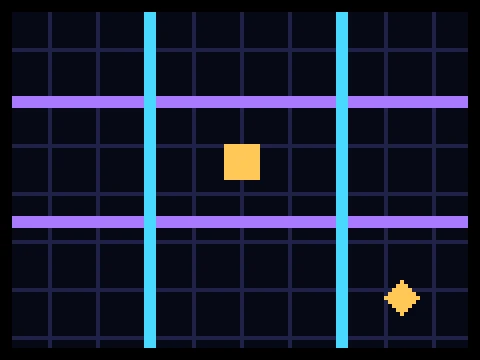
Move through a grid of sweeping laser barriers, collecting data nodes between the gaps.
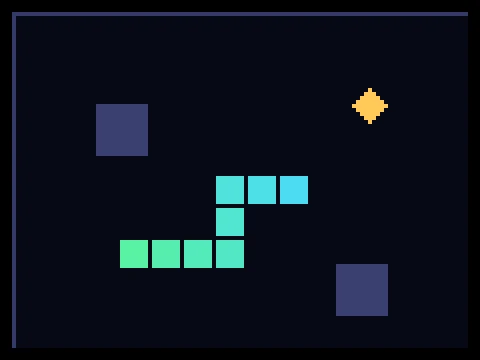
A growing-trail arena game with obstacles, wrap portals, speed tiers and combo scoring.

A brick-breaking game with six original layouts, armoured bricks and five power-ups.
Route planning under a clock, reading periodic hazards, and physics control.
What defines an arcade game, how the six main families differ, and how to get better at all of them.
A clear definition of the genre: origins, defining characteristics, and how browser games continue it.