
Pixel Duel
A draw-on-the-signal reaction duel against a ladder of AI opponents with rising reaction speeds.
Space or tap
Collect orbs and avoid hazards by reversing your orbital direction at the right moment.
One-Tap Arcade is the smallest complete game on the site. Your marker orbits a central hub at a constant speed. Tapping reverses the direction of that orbit. That is the entire control scheme and the entire mechanic. Everything the game does is a variation on where it places things around the ring and how fast the ring turns.
Minimal games live or die on whether the single mechanic has depth, and this one does because reversal is not instantaneous — there is a brief deceleration and acceleration through the turnaround. That means a reversal has a cost measured in arc length, and timing one correctly requires you to predict where you will actually be after the turn rather than where you are when you press. New players reverse when they see a hazard. Experienced players reverse about a third of a second earlier.
The game escalates by adding orbit rings. You start on one. At score thresholds, a second and then a third ring appear at different radii with independently rotating hazard sets, and your marker migrates between them when you collect a ring-shift orb. Managing which ring you are on becomes the strategic layer on top of the reflex layer.
Collect orbs and avoid hazards by reversing your orbital direction at the right moment.
| Input | Action |
|---|---|
| Space, Enter, click or tap anywhere | Reverse orbit direction |
| P or Escape | Pause and resume |
| R | Restart |
Every game on this site can be paused with P or Esc and restarted with R. Sound, retro screen effects and fullscreen are toggled from the buttons above the play area.
Direction changes are not instant — there is a short deceleration and re-acceleration. The practical effect is that a reversal covers extra arc before it takes effect, so inputs must be made earlier than they feel.
A second ring unlocks at 3,000 points and a third at 9,000. Each has its own hazard rotation at a different angular speed. Ring-shift orbs move you between them, and the outer rings are worth more but rotate faster.
Collecting orbs consecutively without a reversal builds a chain bonus. Because reversals are how you avoid hazards, the chain directly rewards routes that need fewer direction changes — which means reading several orbs ahead.
| Action | Value |
|---|---|
| Orb collected | 100 points x chain multiplier |
| Orb chain (no reversal between pickups) | Multiplier rises every 4 orbs, cap x5 |
| Ring shift | 500 points |
| Survival on outer rings | Higher base orb value |
Your best result is saved in this browser only. Nothing is uploaded, and there is no global leaderboard — see the storage policy for exactly what is kept.
Yes. Tap, click or press space — they all do the same thing, which is reverse your orbit.
Collect a ring-shift orb. The second ring unlocks at 3,000 points and the third at 9,000.
There is a deliberate turnaround cost. The input has to come earlier than the moment you need the direction change.
It is the best game on the site for that. A run typically lasts under two minutes and needs no setup at all.
Chosen by shared category, tags and difficulty — not padded with unrelated titles.
A draw-on-the-signal reaction duel against a ladder of AI opponents with rising reaction speeds.
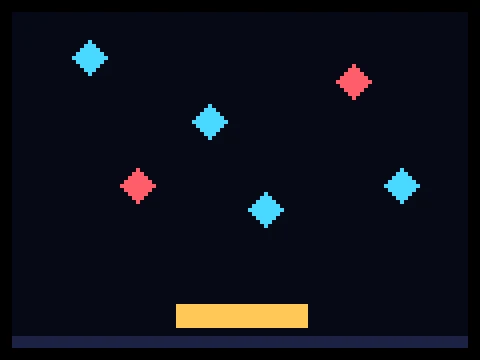
A 90-second round of catching valuable falling objects while avoiding the hazards that reset your streak.
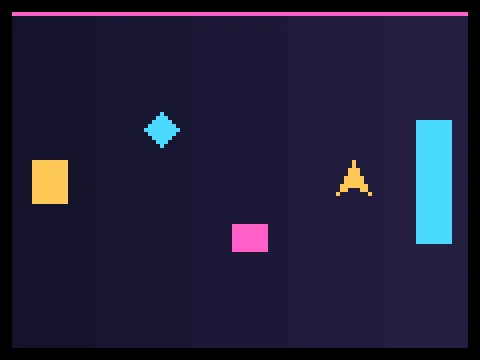
Five arcade challenge types rotating in one continuous run, sharing a single score and life pool.
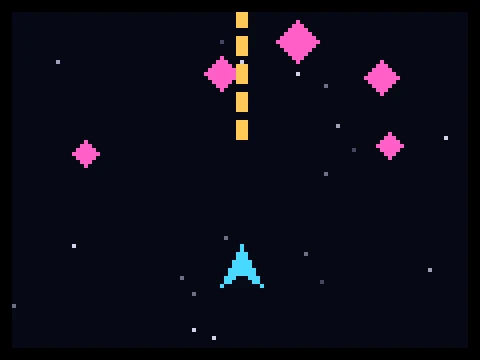
A twin-stick arcade shooter where you move with WASD and aim with the mouse against escalating enemy waves.
Session length, feedback clarity and skill expression — the structural reasons the format endures.
The one-more-run loop, near-miss psychology, self-attributed failure — and keeping it healthy.
Reaction time versus anticipation — what actually improves with practice, and how to train it.